Middle Paleolithic Bifacial Hand Axe Scraper
Prehistoric Lithic Artifacts / Archaeological Antiquities

Middle Paleolithic Bifacial Hand Axe Scraper

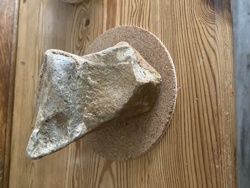
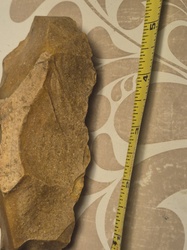
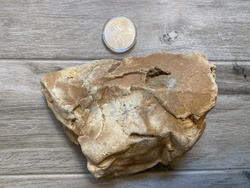
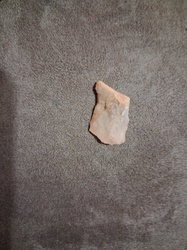
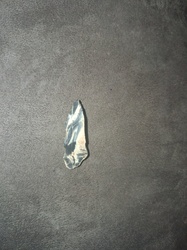
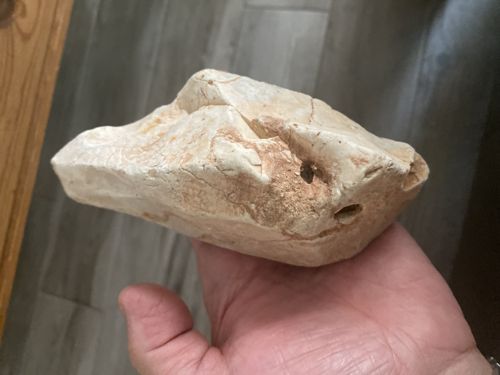
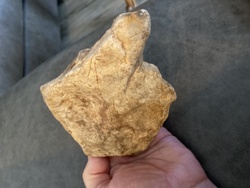
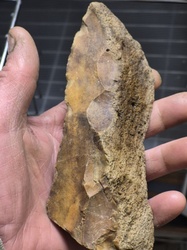
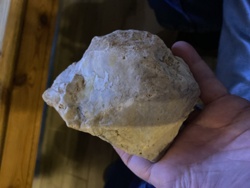
This specimen is a lithic artifact measuring approximately 7 inches by 2.25 inches, identified as a bifacial hand axe or scraper tool sourced from Guthrie, Oklahoma. The item is crafted from a light-colored, tan-to-cream silicate stone, showing a heavy matte patina consistent with long-term environmental exposure. Its construction features bifacial flaking, where material has been removed from both sides to create a tapered, somewhat wedge-shaped profile. The surface displays several prominent percussion scars and flake termination points, particularly along the midsection and towards the narrower bit end. Notably, the artifact contains natural vugs or small cavities in the stone matrix, which may have been present in the original raw material or exacerbated by weathering. The condition shows significant rounding of the once-sharp edges, indicating extensive 'desert varnish' or water-worn smoothing, alongside iron-oxide staining (reddish-brown areas) likely from local soil minerals. There are no modern maker's marks, which is consistent with prehistoric lithic technology. The ergonomics suggest it was designed to be held in the palm for chopping or scraping tasks. While the context suggests Middle Paleolithic, in a North American context, this would traditionally align with Paleo-Indian or Archaic lithic industries, representing a primitive yet functional percussion-flaked tool kit.
Estimated Value

$150 - $250

Basic Information

Category

Prehistoric Lithic Artifacts / Archaeological Antiquities

Appraised On

February 19, 2026

Estimated Value

$150 - $250

Additional Details Provided By Owner

User Provided Information

Middle Paleolithic Bi face Hand axe scraper tool found in Guthrie OK measuring 7" x 2.25"

Item Description

This specimen is a lithic artifact measuring approximately 7 inches by 2.25 inches, identified as a bifacial hand axe or scraper tool sourced from Guthrie, Oklahoma. The item is crafted from a light-colored, tan-to-cream silicate stone, showing a heavy matte patina consistent with long-term environmental exposure. Its construction features bifacial flaking, where material has been removed from both sides to create a tapered, somewhat wedge-shaped profile. The surface displays several prominent percussion scars and flake termination points, particularly along the midsection and towards the narrower bit end. Notably, the artifact contains natural vugs or small cavities in the stone matrix, which may have been present in the original raw material or exacerbated by weathering. The condition shows significant rounding of the once-sharp edges, indicating extensive 'desert varnish' or water-worn smoothing, alongside iron-oxide staining (reddish-brown areas) likely from local soil minerals. There are no modern maker's marks, which is consistent with prehistoric lithic technology. The ergonomics suggest it was designed to be held in the palm for chopping or scraping tasks. While the context suggests Middle Paleolithic, in a North American context, this would traditionally align with Paleo-Indian or Archaic lithic industries, representing a primitive yet functional percussion-flaked tool kit.
Get Your Items Appraised

Instant estimates of your treasures with AI-powered instant appraisals

Browse More Appraisals