AI estimate as of December 16, 2025 · verify with a professional before acting
AI-Generated · Verify before acting
Everything on this page is generated by AI for informational purposes only. AI can make mistakes — the AI may misidentify items or misattribute them (artist, maker, brand, designer, origin, era). This is not an official valuation and should not be used for insurance, sale, tax, estate, legal, or lending purposes — or any decision requiring a certified appraisal. It is not an authoritative claim about any person, brand, or rights holder — do not share or rely on it as a factual statement about a third party. Always consult qualified professionals before making financial decisions.
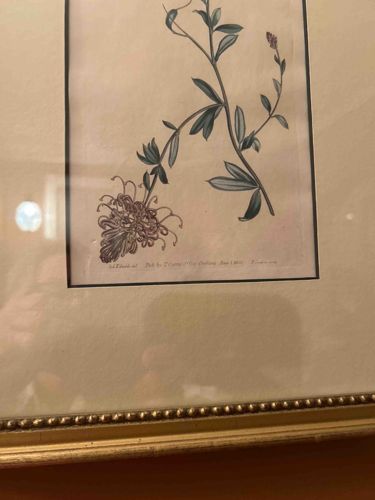
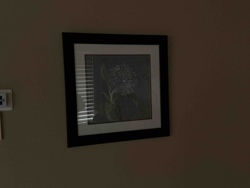
This item is a framed botanical print, depicting a delicate flowering plant, likely a variety of chrysanthemum, alongside a vine with smaller leaves and a bud. The primary image showcases a large, intricate bloom with numerous slender petals, rendered in shades of brown and possibly muted reds, emanating from a central point. Above this bloom, a slender plant stem extends upwards and to the right, adorned with multiple ovate to lanceolate shaped leaves in a soft, grey-green hue. Further up the stem, a small, tightly formed bud, possibly reddish-purple, is visible. The print itself appears to be an engraving or etching, possibly hand-colored, on off-white or lightly toned paper, indicating an older print style commonly found in botanical illustrations from the 18th or 19th century. Below the main botanical illustration, faint, small-font text is discernible, which includes 'J. Edwards del.' (J. Edwards delineated/drawn) and 'Pub by T.Curtis St Geo. Cres. Jan 1, 1801' (Published by T. Curtis, St George's Crescent, January 1, 1801), suggesting its origin as an illustration from a botanical journal or compendium from the early 19th century. The print is housed within a mat board of a light, neutral color, possibly cream or beige, and enclosed in a glass-fronted frame. The frame is gilded, featuring a distressed or antiqued gold finish with a notable ribbed or beaded texture along the inner edge. There are no obvious signs of severe damage such as tears or significant discoloration on the print itself, though minor age-related toning of the paper is possible given its apparent age. The frame shows slight wear consistent with age and handling, but no major breaks or chips are visible, suggesting it maintains good structural integrity. The reflective surface of the glass makes a full condition assessment of the print difficult, but the visible details suggest an item of good quality and historical significance, reflecting the precise scientific and artistic standards of early botanical illustration.
AI Appraisal Report
I have examined the provided image of this framed botanical print. The print, dated January 1, 1801, by T. Curtis and drawn by J. Edwards, depicts a chrysanthemum variety with accompanying vine, rendered with the precision characteristic of early 19th-century botanical illustrations. Based on the discernible text, 'J. Edwards del.' and 'Pub by T.Curtis St Geo. Cres. Jan 1, 1801', the authenticity of the print as an early 19th-century botanical engraving appears strong. The condition of the print appears good from the image; I observe no obvious tears or significant discoloration beyond expected age-related toning. The gilded, distressed frame shows minor wear consistent with its age.
Market conditions for antique botanical prints from this period are generally stable, with a consistent demand from collectors and decorators. Comparables, especially those from well-regarded botanical publications by artists like Edwards, typically fall within a mid-range for single illustrations. The specific 'Chrysanthemum Variety' subject is attractive but not exceptionally rare. Factors impacting value positively include its clear publication details and apparent good condition for its age. Limitations in full authenticity verification stem from the image alone; an in-person examination would be crucial to confirm the print process (engraving/etching, possibly hand-colored), paper quality, and any subtle condition issues not visible through the glass's reflection, such as foxing or creases. Detailed provenance beyond the print itself would also enhance value by confirming its history outside of the current framing.