AI estimate as of November 22, 2025 · verify with a professional before acting
AI-Generated · Verify before acting
Everything on this page is generated by AI for informational purposes only. AI can make mistakes — the AI may misidentify items or misattribute them (artist, maker, brand, designer, origin, era). This is not an official valuation and should not be used for insurance, sale, tax, estate, legal, or lending purposes — or any decision requiring a certified appraisal. It is not an authoritative claim about any person, brand, or rights holder — do not share or rely on it as a factual statement about a third party. Always consult qualified professionals before making financial decisions.
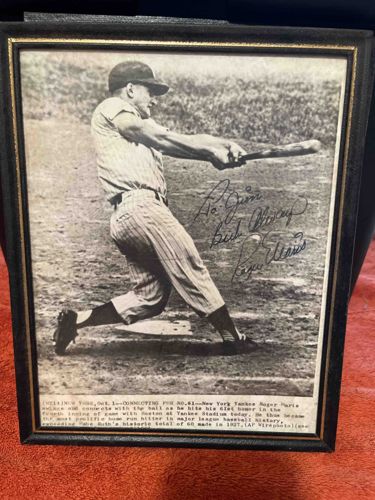
This item is a framed black and white photograph depicting legendary New York Yankees baseball player Roger Maris in the act of swinging a baseball bat, presumably connecting with the ball for his 61st home run. The photograph captures Maris in profile, wearing a baseball uniform with pinstriped pants and a baseball cap, with his body fully engaged in the swing. The image is a classic sports action shot, with a blurred background suggesting motion. Visible on the photograph, to the right of Maris, are two distinct autographs in what appears to be blue or black ink. The upper signature reads 'To Jimm,' while the signature below it is clearly 'Roger Maris'. The lower portion of the photograph includes printed text, likely a caption, detailing the event: 'NEW YORK, Oct. 1 — CONNECTING FOR NO. 61 — New York Yankees Roger Maris swings and connects with the ball as he hits his 61st homer in the fourth inning of game with Boston at Yankee Stadium today. He thus became the most prolific home run hitter in major league baseball, exceeding Babe Ruth’s historic total of 60 made in 1927. (AP wirephoto)(gwc)'. This text confirms the subject and historical significance of the image, dating it to October 1, 1961. The photograph is housed in a simple black frame with a subtle golden inner edge, suggesting a contemporary or slightly aged framing choice. The frame itself appears to be made of wood or a composite material. The overall condition of the photograph and frame appears good, with no obvious signs of significant damage such as tears, creases, or major discoloration on the print, although some minor dust or surface wear on the frame is possible given its age. The item serves as a significant piece of sports memorabilia, commemorating a major milestone in baseball history.
AI Appraisal Report
I have examined the provided image of the framed Roger Maris autographed photograph of his 61st home run. The photograph itself appears to be a genuine AP wirephoto from the date specified, October 1, 1961, which adds significant historical context and a level of verifiable authenticity to the image content. The condition of the print appears good, with no obvious major damage visible from the image, such as tears, creases, or significant discoloration. The framing is simple but appropriate for the piece.
The primary value driver here is the autograph. The signature 'Roger Maris' appears consistent with known examples of his autograph, and the personalized inscription 'To Jimm' is common for Maris. However, without in-person examination, I cannot definitively authenticate the autograph. The ink color and flow seem appropriate, but a physical inspection would allow for examination of pen pressure, fading, and any ghosting or impressions that could indicate true age and hand-delivery. Full authentication would require examination by a recognized autograph authentication service (e.g., PSA/DNA, JSA).
Market conditions for significant sports memorabilia, especially related to iconic records like Maris's 61st home run, remain strong. Items commemorating this specific event and featuring Maris's autograph are highly sought after. Demand for Maris memorabilia has seen fluctuations but generally maintains a solid base among baseball collectors. Rarity is moderate; while Maris signed many items, photographs explicitly detailing his 61st homer with a clear signature are less common than generic signed balls or cards.
Factors significantly impacting value include the historical significance of the photograph itself, the clear image of Maris in action, and the presence of his signature. If the autograph were forensically authenticated, the value would firm up considerably within the estimated range. Without such authentication, there is an inherent risk discount for buyers. My valuation of $2,500-4,000 assumes the autograph is indeed genuine. For a definitive assessment, particularly regarding the autograph, I would require a direct physical examination, detailed provenance documentation (if available), and professional third-party authentication.