AI Appraisal Estimate

AI-generated estimates · not official valuations

From the user

What was submitted

Photo and notes provided by the user — not generated by AI

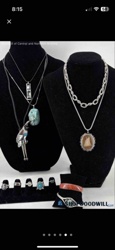
Submitted item photo
Submitted photo · May 23, 2026

User's notes

No additional notes provided.

AI analysis below

AI appraisal

AI analysis & estimate

AI-Generated · Verify before acting

Everything below is generated by AI for informational purposes only. AI can make mistakes — the AI may misidentify items or misattribute them (artist, maker, brand, designer, origin, era). This is not an official valuation and should not be used for insurance, sale, tax, estate, legal, or lending purposes — or any decision requiring a certified appraisal. It is not an authoritative claim about any person, brand, or rights holder — do not share or rely on it as a factual statement about a third party. Always consult qualified professionals before making financial decisions.

Read the full disclaimer

AI Identification

·Not independently authenticated·Verify before acting

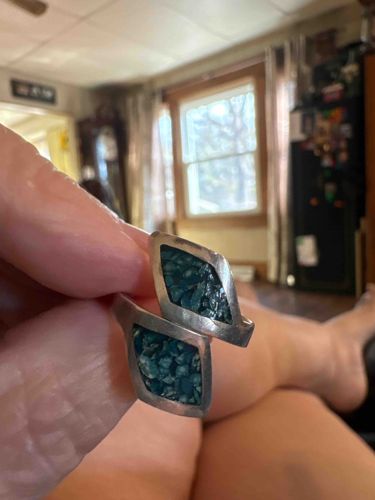
Southwestern Silver Crushed Turquoise Inlay Bypass Ring

Vintage Jewelry

AI Estimated Value

·Not an official valuation·Verify before acting

$65.00 - $115.00

As of May 23, 2026

AI Item Analysis

·AI can make mistakes·Verify before acting
This item is a bypass-style ring crafted in a silver metal, likely sterling silver based on the design vernacular. The ring features two prominent, shield-shaped or elongated diamond-shaped terminals that wrap around the finger. Each terminal is decorated with a mosaic of crushed turquoise chips set in an inlay style. The turquoise displays a deep teal to forest green hue with dark matrix inclusions, which is characteristic of certain Southwestern or Mexican turquoise mines. The construction appears to be cast or fabricated with a smooth, brushed finish on the outer bands. In terms of condition, the piece shows a moderate level of surface patina and fine micro-scratches consistent with vintage wear. The inlay appears largely intact, though there is some unevenness in the surface of the stone fragments. The style is strongly indicative of Southwestern Native American or Mexican Taxco jewelry from the mid-to-late 20th century (circa 1960s-1980s). The bypass design provides a modernist aesthetic while utilizing traditional gemstone materials. Measurement is not provided, but the terminals are substantial, occupying a significant portion of the phalange. No visible hallmarking is apparent in this view, though '925' or 'MEXICO' or a maker's mark would typically be found on the interior shank.
AI Appraisal Report

·AI can make mistakes·Verify before acting
Based on my direct visual examination of the Southwestern Silver Crushed Turquoise Inlay Bypass Ring, I have assessed it as a mid-to-late 20th-century piece, likely of Mexican or Southwestern origin. The construction utilizes a crushed turquoise chip inlay technique, which gained significant popularity in the 1970s as a way to utilize smaller gemstone fragments within a 'mosaic' aesthetic. The bypass design is a classic modernist form, and the substantial size of the terminals suggests it was intended as a statement piece. The condition is 'Good' for vintage jewelry; the surface patina on the silver alloy is consistent with its age, and the minor micro-scratching does not detract from the overall appeal. However, the unevenness in the inlay indicates a mass-market production rather than high-end lapidary work. Market demand for this specific style remains steady among 'Vintage Southwestern' collectors, though it is not as rare as traditional solid stone channel inlay or signed Navajo/Zuni pieces. Factors impacting value include the lack of visible hallmarks; if a 'Sterling' or '925' mark were present along with a recognized maker's mark (e.g., Bell Trading Post or a specific Taxco workshop), the value would trend toward the higher end of the range. Limitations: This appraisal is based on photographic evidence alone. I cannot definitively verify the silver purity (which may be 'Alpaca' or nickel silver rather than sterling) without a professional acid test. Furthermore, I cannot confirm if the turquoise is natural or stabilized/dyed without microscopic inspection. A full authentication would require physical testing for metal density and provenance documentation to confirm the artisan's origin.

Get your items appraised

Instant estimates of your treasures with AI-powered appraisals

Browse More Appraisals