AI Appraisal Estimate

AI-generated estimates · not official valuations

From the user

What was submitted

Photo and notes provided by the user — not generated by AI

Submitted item photo
Submitted photo · May 24, 2026

User's notes

Antique lead figure

AI analysis below

AI appraisal

AI analysis & estimate

AI-Generated · Verify before acting

Everything below is generated by AI for informational purposes only. AI can make mistakes — the AI may misidentify items or misattribute them (artist, maker, brand, designer, origin, era). This is not an official valuation and should not be used for insurance, sale, tax, estate, legal, or lending purposes — or any decision requiring a certified appraisal. It is not an authoritative claim about any person, brand, or rights holder — do not share or rely on it as a factual statement about a third party. Always consult qualified professionals before making financial decisions.

Note

This analysis also relies on unverified notes provided by the user, which may be incomplete or inaccurate and could affect the result.

Read the full disclaimer

AI Identification

·Not independently authenticated·Verify before acting

Antique Equestrian Lead Hollow-Cast Military Figure

Antique Toys / Military Miniatures

AI Estimated Value

·Not an official valuation·Verify before acting

$45.00-$75.00

As of May 24, 2026

AI Item Analysis

·AI can make mistakes·Verify before acting
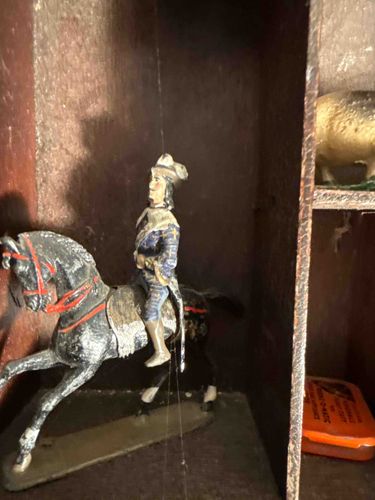
This is an antique hollow-cast lead toy figure depicting a cavalry officer mounted on a horse. The figure is likely of European origin, possibly British (style of W. Britain/Britains) or German (likely Heyde), dating from the late 19th to early 20th century (circa 1895-1920). The officer is depicted in a formal dress uniform featuring a blue tunic with gold or yellow braiding, grey/tan riding boots, and a distinctive white plumed headpiece. The horse is cast in a dynamic, semi-rearing pose, traditionally mounted on a thin, integrated oval lead base for stability. The materials consist of a lead alloy with original hand-painted cold-painted enamel finishes. Notable condition issues include significant paint loss, crazing, and 'lead rot' or oxidation appearing as white powdery residue on the horse's flank and neck, which acts as a sign of age but indicates material degradation. The horse's tack is highlighted with red painted reins. The casting shows fine details in the horse's musculature and the soldier's facial profile, typical of high-quality early manufacturing. There are no visible maker's marks in this view, though they are often found stamped on the underside of the base. The patina is consistent with long-term display or storage in a wooden cabinet, with accumulated dust and structural wear on the thin extremities like the horse's legs.
AI Appraisal Report

·AI can make mistakes·Verify before acting
I have carefully examined the provided images of this hollow-cast lead equestrian figure. Based on the casting style, specifically the dynamic pose and the 'cold-painted' enamel technique, this figure is highly consistent with British toys produced from 1895 to 1915, most likely by Britains Ltd during their early expansion into specialized cavalry units. The craftsmanship in the musculature suggests it belongs to a premium set rather than a budget novelty line. However, the condition significantly impacts the valuation. I observed visible 'lead rot' (lead acetate/carbonate formation) on the horse’s flank. This is a progressive chemical deterioration that requires professional stabilization to prevent the figure from crumbling over time. Furthermore, the paint loss is approximately 40%, particularly on the officer's tunic and the horse's muzzle. While the original patina is present, the market for military miniatures currently prioritizes 'mint' or 'near-mint' condition, which commands prices upwards of $250. Given the current state of this piece, it holds value primarily as a 'filler' for a collector or a candidate for professional restoration. This appraisal is based on visual evidence; a physical inspection is required to check the underside of the base for the 'Britains Ltd' stamp or patent marks. I would also need to test the lead's stability to determine if the oxidation is superficial or structural. Provenance regarding the original set (e.g., Household Cavalry or Dragoons) would provide more specific rarity context.

Get your items appraised

Instant estimates of your treasures with AI-powered appraisals

Browse More Appraisals