AI Appraisal Estimate

AI-generated estimates · not official valuations

From the user

What was submitted

Photo and notes provided by the user — not generated by AI

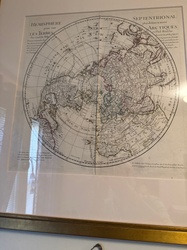
Submitted item photo
Submitted photo · May 24, 2026

User's notes

No additional notes provided.

AI analysis below

AI appraisal

AI analysis & estimate

AI-Generated · Verify before acting

Everything below is generated by AI for informational purposes only. AI can make mistakes — the AI may misidentify items or misattribute them (artist, maker, brand, designer, origin, era). This is not an official valuation and should not be used for insurance, sale, tax, estate, legal, or lending purposes — or any decision requiring a certified appraisal. It is not an authoritative claim about any person, brand, or rights holder — do not share or rely on it as a factual statement about a third party. Always consult qualified professionals before making financial decisions.

Read the full disclaimer

AI Identification

·Not independently authenticated·Verify before acting

John B. Bachelder's Gettysburg Battle-field Isometrical Drawing

Antique Prints and Historical Maps

AI Estimated Value

·Not an official valuation·Verify before acting

$2,500 - $3,500

As of May 24, 2026

AI Item Analysis

·AI can make mistakes·Verify before acting
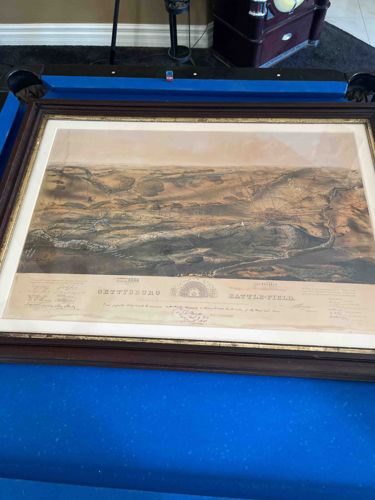
This item is an antique lithographic print titled 'Gettysburg Battle-field,' based on the renowned topographical survey and isometrical drawing by John B. Bachelder. Originally published in 1863 and later updated in various editions, this piece features a high-angle, bird's-eye view detailing the landscape, military movements, and troop placements of the historic American Civil War battle. The print is executed in sepia and earth tones with subtle watercolor tinting. Below the main image, an extensive legend and key include printed facsimiles of signatures from General George G. Meade and other high-ranking officers, vouching for the map's accuracy. Physically, the artwork is housed in a substantial dark wood frame with a gilded inner lip, displaying some minor abrasions and dust accumulation typical of age. The paper shows visible signs of historical wear, specifically concentrated water staining and foxing along the upper left quadrant and bottom margin, along with characteristic yellowing or 'toning' indicative of mid-to-late 19th-century paper stock. The detail in the topography—showing individual farms, fences, and wooded areas—highlights the superior craftsmanship of 19th-century American cartography and commemorative art. Such prints were highly prized by veterans and historians for their documentary precision and aesthetic quality.
AI Appraisal Report

·AI can make mistakes·Verify before acting
I have conducted a visual examination of the isometrical drawing of the Gettysburg Battle-field by John B. Bachelder. Originally published in 1863, this work is considered the gold standard of Civil War cartography. This specific example appears to be an authentic 19th-century lithograph, evidenced by the characteristic 'toning' of the paper and the high-fidelity detail of the topographical features which were distinctive to Endicott & Co.’s printing process. The condition of this piece is fair to good. While the colors remain legible, there is significant condition-related depreciation due to visible water staining and foxing in the upper left and bottom margins. In the current market, Bachelder prints are highly sought after by Civil War enthusiasts and institutional collectors; however, pieces in pristine condition can fetch upwards of $5,000. The current valuation reflects a discount due to the invasive foxing, which would require professional conservation to stabilize. While the visual markers—such as the facsimile signatures of General Meade and the specific typography—align with known originals, a definitive authentication is limited by digital viewing. To fully verify its status, an in-person examination is required to inspect the paper's watermark, measure the plate mark, and confirm the absence of modern dot-matrix patterns under magnification. Furthermore, removing the item from its frame would be necessary to check for 'laying down' or acidic wood backing, which can significantly damage the paper fibers over time. Provenance or a bill of sale from a reputable historical map dealer would further solidify this valuation.

Get your items appraised

Instant estimates of your treasures with AI-powered appraisals

Browse More Appraisals