AI Appraisal Estimate

AI-generated estimates · not official valuations

From the user

What was submitted

Photo and notes provided by the user — not generated by AI

Submitted item photo
Submitted photo · June 17, 2026

User's notes

No additional notes provided.

AI analysis below

AI appraisal

AI analysis & estimate

AI-Generated · Verify before acting

Everything below is generated by AI for informational purposes only. AI can make mistakes — the AI may misidentify items or misattribute them (artist, maker, brand, designer, origin, era). This is not an official valuation and should not be used for insurance, sale, tax, estate, legal, or lending purposes — or any decision requiring a certified appraisal. It is not an authoritative claim about any person, brand, or rights holder — do not share or rely on it as a factual statement about a third party. Always consult qualified professionals before making financial decisions.

Read the full disclaimer

AI Identification

·Not independently authenticated·Verify before acting

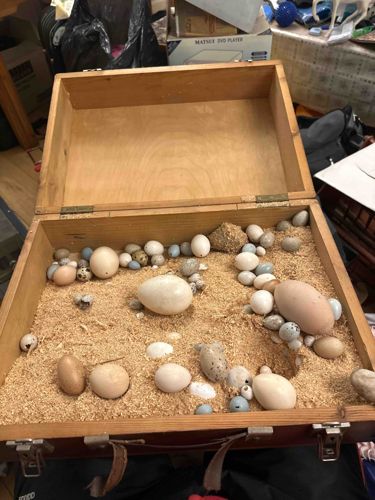
Vintage Oological Collection in Wooden Display Case

Natural History Collectibles / Oology

AI Estimated Value

·Not an official valuation·Verify before acting

$50 - $150 (Commercial Value heavily restricted)

As of June 17, 2026

AI Item Analysis

·AI can make mistakes·Verify before acting
This item is a vintage natural history collection consisting of various bird eggs housed within a utilitarian wooden briefcase-style chest. The collection comprises approximately 40 to 50 bird eggs of diverse species, ranging in size from small passerine eggs (approx. 1 cm) to large waterbird or poultry eggs (approx. 7–8 cm). The eggs exhibit a variety of colors including chalky white, pale blue, buff, and speckled/mottled patterns in shades of brown and grey. They are presented on a bed of fine wood shavings (sawdust), which serves as a protective cushioning material. The wooden case is constructed from lightweight plywood or pine with a natural finish, featuring metal hinges and front latches. A leather or faux-leather carrying handle is visible, showing significant wear. The interior of the lid is plain wood without a liner. Condition-wise, the eggs appear fragile; several show visible cracks or small puncture holes consistent with common oological preservation techniques (blowing). The box itself shows exterior scuffing, oxidation on the metal hardware, and some staining on the wood. This collection likely dates from the early to mid-20th century, a period when amateur oology was a common hobby. Note: Possession of wild bird eggs is subject to strict legal regulations globally (e.g., the Migratory Bird Treaty Act in the US or Wildlife and Countryside Act in the UK), which heavily impacts the legal appraisal and transfer of such items.
AI Appraisal Report

·AI can make mistakes·Verify before acting
I have examined the images of this vintage oological collection, which presents a significant challenge for appraisal due to strict legal frameworks surrounding wildlife specimens. Visually, the collection appears to be a genuine amateur assemblage from the mid-20th century, likely dating between 1930 and 1960. The wooden display case, utilitarian in construction with ply and pine, shows age-appropriate oxidation on the hardware and significant wear on the handle, consistent with this era. The eggs themselves display the tell-tale single blow-holes used for draining contents, a standard preservation technique of the time. However, condition is a major detractor; several specimens exhibit distinct hairline cracks and fragility, and the presentation on loose wood shavings is less desirable than organized, labeled compartments. The primary factor impacting value here is legality, not aesthetics. In the United States, the Migratory Bird Treaty Act (MBTA) makes it illegal to sell, purchase, or barter eggs of native migratory birds unless they possess documented pre-Act provenance (pre-1918) or specific permits, which are rarely granted for commercial trade. Without species-specific labeling and provenance documentation, this collection is effectively commercially unsalable in major markets. In the UK and EU, similar restrictions apply under CITES and local wildlife acts. Consequently, the assigned value reflects only the potential value of the non-protected species (e.g., domestic poultry or invasive species like Starlings/Sparrows) or the case itself as a curiosity. For a full authentication, I would require an in-person species identification by an ornithologist to determine if any legal-to-trade species are present, alongside a review of any historical paperwork proving the collection's age.

Get your items appraised

Instant estimates of your treasures with AI-powered appraisals

Browse More Appraisals