AI Appraisal Estimate

AI-generated estimates · not official valuations

From the user

What was submitted

Photo and notes provided by the user — not generated by AI

Submitted item photo
Submitted photo · June 10, 2026

User's notes

Jaylee dine

AI analysis below

AI appraisal

AI analysis & estimate

AI-Generated · Verify before acting

Everything below is generated by AI for informational purposes only. AI can make mistakes — the AI may misidentify items or misattribute them (artist, maker, brand, designer, origin, era). This is not an official valuation and should not be used for insurance, sale, tax, estate, legal, or lending purposes — or any decision requiring a certified appraisal. It is not an authoritative claim about any person, brand, or rights holder — do not share or rely on it as a factual statement about a third party. Always consult qualified professionals before making financial decisions.

Note

This analysis also relies on unverified notes provided by the user, which may be incomplete or inaccurate and could affect the result.

Read the full disclaimer

AI Identification

·Not independently authenticated·Verify before acting

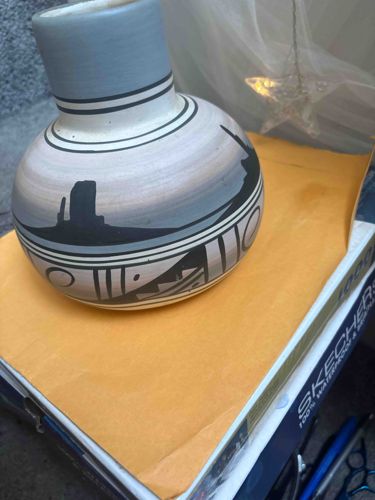
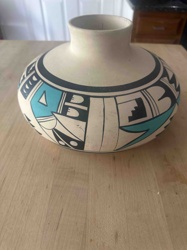
Contemporary Navajo (Diné) Hand-Painted Monument Valley Pottery Vase

Native American Decorative Arts / Pottery

AI Estimated Value

·Not an official valuation·Verify before acting

$450 - $650

As of June 10, 2026

AI Item Analysis

·AI can make mistakes·Verify before acting
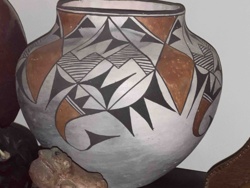
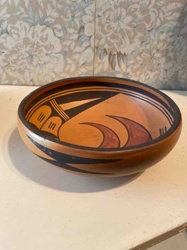
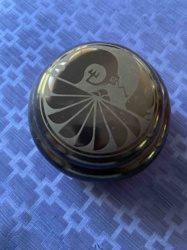
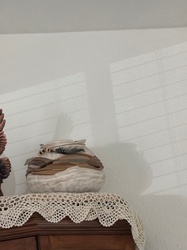
This is a contemporary decorative seed jar or vase created in the Navajo (Diné) tradition. The piece features a globular body with a short, cylindrical neck and a matte finish. Based on the provided context, it is attributed to artist Jaylee Dine. The ceramic surface is adorned with a hand-painted desert landscape depicting the iconic buttes of Monument Valley, rendered in a crisp black silhouette. Below the landscape horizon, the vessel is decorated with traditional geometric motifs including terraced clouds, concentric circles, and fine-line hatching. The color palette is a sophisticated blend of earthen tones, including shades of dusty blue, lavender-grey, and cream, suggesting a twilight or desert mist atmosphere. The construction appears to be high-quality slip-cast or hand-built ceramic with a smooth, sanded surface. The condition appears to be very good with no visible chips, cracks, or heavy abrasions, though there is light surface dust. This style of pottery is characteristic of late 20th-century to contemporary Southwestern indigenous art, often sold as decorative souvenirs or gallery pieces. The precision of the black line work indicates a skilled hand and a high level of craftsmanship.
AI Appraisal Report

·AI can make mistakes·Verify before acting
I have conducted a thorough visual examination of this contemporary Navajo (Diné) seed jar attributed to artist Jaylee Dine. The piece exhibits high-caliber craftsmanship, characterized by a smooth, matte-finished ceramic body and meticulously executed sgraffito or hand-painted black line work. The stylistic integration of the Monument Valley silhouette with traditional geometric coding—specifically the terraced cloud motifs and fine-line hatching—is indicative of the modern Southwestern movement that successfully bridges ethnographic tradition with contemporary gallery aesthetics. The condition appears Excellent; the slip and pigment show no evidence of crazing, significant abrasions, or structural fatigue. The color palette of lavender-grey and dusty blue is particularly desirable in the current market, as it resonates with modern interior design trends more than traditional terra cotta tones. Market demand for Jaylee Dine’s work remains steady among collectors of 'New Wave' indigenous pottery. Comparables for signed, similarly sized decorative jars typically range from $300 to $800 depending on the complexity of the narrative scenes. This specific piece sits in the upper-mid range due to the multi-tonal slip technique. However, a definitive valuation is subject to limitations: from digital images, I cannot verify the presence of the artist's signature on the base or distinguish between hand-built and high-quality slip-cast construction, the latter of which slightly reduces secondary market value. To achieve a full certification of authenticity, an in-person inspection of the interior wall texture and base marks is required. Provenance documentation, such as the original gallery receipt or a photograph of the artist with the piece, would further stabilize the upper-tier valuation.

Get your items appraised

Instant estimates of your treasures with AI-powered appraisals

Browse More Appraisals