Meissen Crossed Swords Porcelain Mark
Antique Ceramics and Porcelain

Meissen Crossed Swords Porcelain Mark

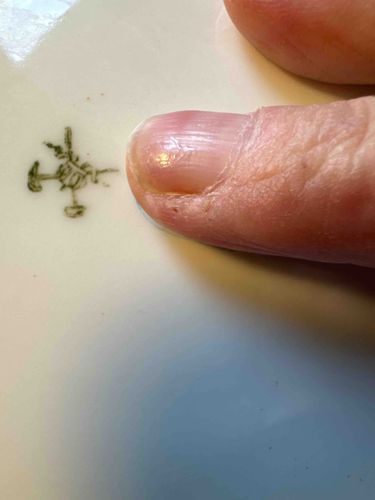
This image features the characteristic 'Crossed Swords' hallmark of the Meissen Porcelain Manufactory, located on what appears to be a fine white porcelain surface. The mark is applied in an underglaze cobalt blue or dark green hue and depicts two crossed rapiers with pummels. The small scale of the mark, as demonstrated by the adjacent human finger, suggests it may be a kiln mark or a secondary factory mark often found on the underside of figures, dinnerware, or decorative objects. The porcelain body displays a smooth, vitreous glaze with a high-luster finish and a warm, creamy-white tone typical of eighteenth or nineteenth-century European hard-paste porcelain. Observation of the mark shows slight bleeding into the glaze, a characteristic of authentic hand-applied underglaze marks before the standardization of transfer printing. Historically, this specific mark was introduced around 1720 to prevent counterfeiting and has evolved through various iterations (such as the Marcolini period with a star or the Dot period). The surface shows minor micro-scratches and two very small dark inclusions or 'kiln dust' specks, which are common in historical porcelain fired in wood-fueled kilns. The overall quality of the glaze indicates a high level of craftsmanship consistent with Saxon royal porcelain production.

Estimated Value

$400 - $1,200

Basic Information

Category

Antique Ceramics and Porcelain

Appraised On

January 10, 2026

Estimated Value

$400 - $1,200

Item Description

This image features the characteristic 'Crossed Swords' hallmark of the Meissen Porcelain Manufactory, located on what appears to be a fine white porcelain surface. The mark is applied in an underglaze cobalt blue or dark green hue and depicts two crossed rapiers with pummels. The small scale of the mark, as demonstrated by the adjacent human finger, suggests it may be a kiln mark or a secondary factory mark often found on the underside of figures, dinnerware, or decorative objects. The porcelain body displays a smooth, vitreous glaze with a high-luster finish and a warm, creamy-white tone typical of eighteenth or nineteenth-century European hard-paste porcelain. Observation of the mark shows slight bleeding into the glaze, a characteristic of authentic hand-applied underglaze marks before the standardization of transfer printing. Historically, this specific mark was introduced around 1720 to prevent counterfeiting and has evolved through various iterations (such as the Marcolini period with a star or the Dot period). The surface shows minor micro-scratches and two very small dark inclusions or 'kiln dust' specks, which are common in historical porcelain fired in wood-fueled kilns. The overall quality of the glaze indicates a high level of craftsmanship consistent with Saxon royal porcelain production.
Get Your Items Appraised

Instant estimates of your treasures with AI-powered instant appraisals

Browse More Appraisals