AI Appraisal Estimate

AI-generated estimates · not official valuations

From the user

What was submitted

Photo and notes provided by the user — not generated by AI

Submitted item photo
Submitted photo · May 24, 2026

User's notes

No additional notes provided.

AI analysis below

AI appraisal

AI analysis & estimate

AI-Generated · Verify before acting

Everything below is generated by AI for informational purposes only. AI can make mistakes — the AI may misidentify items or misattribute them (artist, maker, brand, designer, origin, era). This is not an official valuation and should not be used for insurance, sale, tax, estate, legal, or lending purposes — or any decision requiring a certified appraisal. It is not an authoritative claim about any person, brand, or rights holder — do not share or rely on it as a factual statement about a third party. Always consult qualified professionals before making financial decisions.

Read the full disclaimer

AI Identification

·Not independently authenticated·Verify before acting

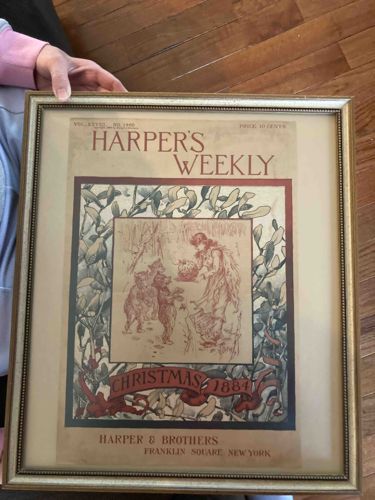
Framed Harper's Weekly Christmas 1884 Cover

Antique Ephemera and Prints

AI Estimated Value

·Not an official valuation·Verify before acting

$175 - $250

As of May 24, 2026

AI Item Analysis

·AI can make mistakes·Verify before acting
This item is a framed cover from the December 1884 Christmas edition of Harper's Weekly, a prominent American political magazine based in New York City. The cover features an ornate, woodblock-style illustration depicting a whimsical scene of a young woman offering a pudding to three upright, dancing bears in a snowy forest. This central image is framed by a lush border of mistletoe and foliage, with a red banner at the bottom stating 'CHRISTMAS 1884'. The masthead at the top displays 'HARPER'S WEEKLY' followed by the price of '10 CENTS' and the volume/issue numbering (Vol. XXVIII, NO. 1460). The bottom identifies the publisher as 'HARPER & BROTHERS, FRANKLIN SQUARE, NEW YORK'. Physically, the print shows significant foxing and toning consistent with 19th-century newsprint paper. There are visible creases, most notably a vertical fold line through the center, suggesting it was once folded for distribution. The colors are muted, relying primarily on black, red, and earth tones on aged paper. It is housed in a modern gold-toned wood frame with beaded interior detailing and a simple cream matboard. The print appears to be an original antique page rather than a reproduction, though a full removal from the frame would be required to verify margins and paper weight. The craftsmanship reflects the high-quality wood engraving and lithography techniques of the late Victorian era.
AI Appraisal Report

·AI can make mistakes·Verify before acting
I have carefully examined the provided images of the Harper's Weekly cover dated December 20, 1884. This piece is a notable example of late Victorian commercial lithography, featuring 'A Christmas Morning in the Woods' by notable illustrator Frank Bellew. Based on my visual assessment, the print exhibits characteristics consistent with 19th-century newsprint, including 'foxing' (rusty brown spotting), acid-burn toning, and a prominent vertical fold line typical of periodicals distributed via mail. The presence of these aging markers suggests the piece is an original page rather than a modern reprint. The market for Harper’s Weekly ephemera is stable but highly dependent on the desirability of the artist and the subject matter. Holiday-themed covers are generally more sought after than political or news-focused editions. Current comparables for framed late-19th-century covers range from $150 to $300 in retail gallery settings. The value is moderately constrained by the visible condition issues—specifically the heavy foxing in the upper quadrants—and the use of a standard mat rather than museum-quality acid-free materials, which may have contributed to further edge darkening. While the typography and paper texture observed in the image support an 1884 origin, a full authentication requires removing the print from the frame to inspect the 'bleed-through' of the reverse-side text and verify the paper's weight and fiber content. Without examining the margins for binding holes or checking the watermark, I cannot rule out high-quality 20th-century facsimiles. For insurance purposes, I recommend a physical inspection to ensure no active mold is present within the foxing spots, which could deteriorate the paper further.

Get your items appraised

Instant estimates of your treasures with AI-powered appraisals

Browse More Appraisals