Sacagawea Dollar Coin
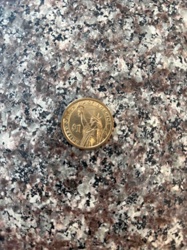
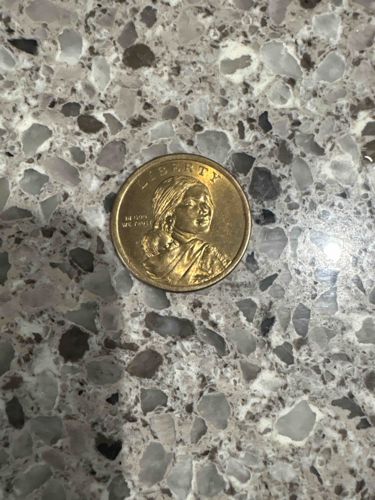
This is a United States Sacagawea dollar coin, commonly referred to as the 'Golden Dollar' due to its manganese-brass cladding which gives it a distinct yellow-gold appearance. The obverse side, shown in the image, features a portrait of Sacagawea, the Shoshone guide of the Lewis and Clark Expedition, carrying her infant son, Jean Baptiste Charbonneau, in a papoose on her back. This design was created by artist Glenna Goodacre. The coin is composed of a pure copper core with an outer layer of 77% copper, 12% zinc, 7% manganese, and 4% nickel. Physically, the coin measures 26.5 mm in diameter and weighs approximately 8.1 grams with a plain (smooth) edge, though later iterations (2009 onwards) moved the date and mint mark to the edge. The coin in the image exhibits signs of light circulation, including minor surface abrasions, small contact marks, and a slight darkening or 'toning' typical of manganese-brass alloy when handled. No major gouges or deep scratches are visible in this view. The strike appears to be of standard business-strike quality with moderate detail preserved in the hair and facial features of the figures. First minted in 2000, these coins were produced in large quantities for general circulation, though they eventually transitioned primarily to collector-focused production.
AI-Generated Appraisal Disclaimer
Estimated Value
$1.00 - $1.25
Basic Information
Category
Numismatics / Currency
Appraised On
February 14, 2026
Estimated Value
$1.00 - $1.25
Item Description
This is a United States Sacagawea dollar coin, commonly referred to as the 'Golden Dollar' due to its manganese-brass cladding which gives it a distinct yellow-gold appearance. The obverse side, shown in the image, features a portrait of Sacagawea, the Shoshone guide of the Lewis and Clark Expedition, carrying her infant son, Jean Baptiste Charbonneau, in a papoose on her back. This design was created by artist Glenna Goodacre. The coin is composed of a pure copper core with an outer layer of 77% copper, 12% zinc, 7% manganese, and 4% nickel. Physically, the coin measures 26.5 mm in diameter and weighs approximately 8.1 grams with a plain (smooth) edge, though later iterations (2009 onwards) moved the date and mint mark to the edge. The coin in the image exhibits signs of light circulation, including minor surface abrasions, small contact marks, and a slight darkening or 'toning' typical of manganese-brass alloy when handled. No major gouges or deep scratches are visible in this view. The strike appears to be of standard business-strike quality with moderate detail preserved in the hair and facial features of the figures. First minted in 2000, these coins were produced in large quantities for general circulation, though they eventually transitioned primarily to collector-focused production.
Get Your Items Appraised
Instant estimates of your treasures with AI-powered instant appraisals