AI Appraisal Estimate

AI-generated estimates · not official valuations

From the user

What was submitted

Photo and notes provided by the user — not generated by AI

Submitted item photo
Submitted photo · June 17, 2026

User's notes

Broach

AI analysis below

AI appraisal

AI analysis & estimate

AI-Generated · Verify before acting

Everything below is generated by AI for informational purposes only. AI can make mistakes — the AI may misidentify items or misattribute them (artist, maker, brand, designer, origin, era). This is not an official valuation and should not be used for insurance, sale, tax, estate, legal, or lending purposes — or any decision requiring a certified appraisal. It is not an authoritative claim about any person, brand, or rights holder — do not share or rely on it as a factual statement about a third party. Always consult qualified professionals before making financial decisions.

Note

This analysis also relies on unverified notes provided by the user, which may be incomplete or inaccurate and could affect the result.

Read the full disclaimer

AI Identification

·Not independently authenticated·Verify before acting

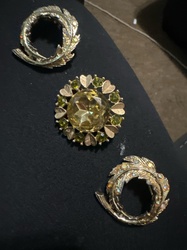
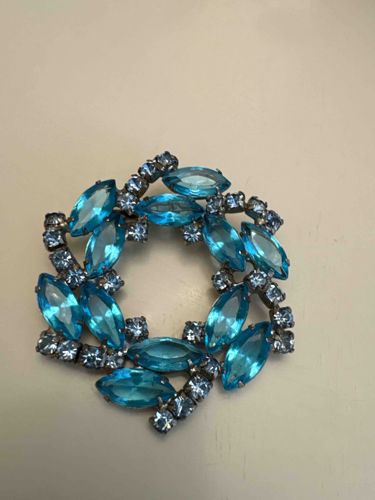
Vintage Aquamarine Glass Rhinestone Wreath Brooch

Vintage Costume Jewelry

AI Estimated Value

·Not an official valuation·Verify before acting

$45.00 - $65.00

As of June 17, 2026

AI Item Analysis

·AI can make mistakes·Verify before acting
This is a circular wreath-style costume jewelry brooch, likely dating from the mid-20th century (circa 1950s-1960s). The piece is constructed with a silver-tone metal base, featuring a classic prong-set arrangement. It prominently displays eleven marquise-cut (eye-shaped) faceted glass rhinestones in a vibrant aquamarine or sky blue hue. These larger stones are arranged in an overlapping, clockwise radial pattern that creates a sense of movement. Interspersed between and bordering the larger stones are clusters of smaller, round-cut clear or light blue chaton rhinestones, also secured in individual metal prongs. The overall diameter appears to be approximately 1.5 to 2 inches. In terms of condition, there is visible darkening and oxidation on the metal prongs, common for vintage pot metal or rhodium-plated alloys. The stones appear to be intact without major chips, though some of the smaller round stones show signs of 'greying' or foil backing degradation, which is typical for stones of this age. The craftsmanship reflects mass-produced but high-quality mid-century costume jewelry, characterized by sturdy prong settings rather than simple adhesive. No designer mark is visible from the front view, though its aesthetic is consistent with manufacturers like Coro or Trifari of that era.
AI Appraisal Report

·AI can make mistakes·Verify before acting
I have examined the digital representation of this mid-century wreath-style brooch. Based on the construction, this piece is a classic example of post-WWII costume jewelry, likely dating between 1950 and 1965. The use of marquise-cut aquamarine glass stones set in a radial 'pinwheel' pattern is indicative of the 'New Look' era aesthetic. The condition assessment reveals typical wear patterns for its age. While the stones remain vibrant, I observe 'greying' in the smaller round chatons, caused by the oxidation of the foil backing (mercury or silver). The metal shows signs of patina and pitting consistent with rhodium-plated base metal. The presence of hand-set prongs elevates this above modern 'glued-on' reproductions, though the absence of a visible maker's mark suggests it was produced for a mass-market retailer rather than a premium house like Weiss or Eisenberg. The current market for unsigned mid-century brooches is stable but saturated. Collectors currently favor high-contrast colors or signed 'parures' (matching sets). Consequently, the value is derived primarily from its aesthetic appeal and 'wearability' rather than historical rarity. Limitations: This appraisal is based on photographic evidence only. A physical inspection is required to test the metal for lead or nickel content and to examine the pin mechanism for repairs. To fully authenticate the piece or link it to a specific designer (like Coro), I would need to inspect the reverse side for hidden hallmarks or patent numbers. Scientific testing (refractometry) would be necessary to confirm the stones are glass and not synthetic spinel, though the visible foil degradation strongly suggests glass construction.

Get your items appraised

Instant estimates of your treasures with AI-powered appraisals

Browse More Appraisals