AI estimate as of November 19, 2025 · verify with a professional before acting
AI-Generated · Verify before acting
Everything on this page is generated by AI for informational purposes only. AI can make mistakes — the AI may misidentify items or misattribute them (artist, maker, brand, designer, origin, era). This is not an official valuation and should not be used for insurance, sale, tax, estate, legal, or lending purposes — or any decision requiring a certified appraisal. It is not an authoritative claim about any person, brand, or rights holder — do not share or rely on it as a factual statement about a third party. Always consult qualified professionals before making financial decisions.
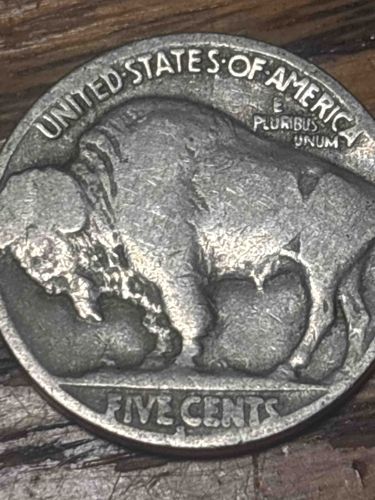
This item is the reverse side of a United States Buffalo Nickel. It features a depiction of an American bison (buffalo) standing on a mound of earth. The inscriptions 'UNITED STATES OF AMERICA' curve along the top rim of the coin, with the motto 'E PLURIBUS UNUM' positioned in smaller letters above the buffalo's back. Below the buffalo, along the bottom rim, are the words 'FIVE CENTS'. The coin appears to be made of a cupro-nickel alloy, typical for this denomination. Its color is a dull, somewhat oxidized silver-gray, indicating significant age and circulation. The surface shows considerable wear, particularly on the higher points of the buffalo's body, which are smoother and less defined. There are numerous scratches, nicks, and abrasions visible across the entire surface, suggesting heavy use. The details of the buffalo's fur, while still discernible, are softened dûe to wear. The borders of the coin are mostly intact, though some edge wear is noticeable. No specific mint mark or date is visible on this side, as those features are typically found on the obverse. This coin represents a vintage American numismatic piece, likely from the early to mid-20th century (1913-1938), a period characterized by distinctive and often artistic coin designs.
AI Appraisal Report
I have examined the provided image of the reverse side of a United States Buffalo Nickel. Based on this visual inspection, the coin exhibits significant wear, consistent with considerable circulation. The higher points of the buffalo's design are noticeably smoothed, and fur details are softened. The coin displays numerous scratches, nicks, and abrasions across its surface. The general appearance suggests a cupro-nickel alloy with typical oxidation for its age. This indicates a low-grade condition, likely Good (G) to Very Good (VG) on the Sheldon scale. Authenticity, based solely on the image, appears to be consistent with a genuine Buffalo Nickel reverse. The design elements, inscriptions ('UNITED STATES OF AMERICA', 'E PLURIBUS UNUM', 'FIVE CENTS'), and overall appearance match known characteristics of the series (1913-1938).
Market conditions for common date, heavily worn Buffalo Nickels are generally low. These coins are readily available in the numismatic market through various dealers and online platforms. Demand in this condition is primarily from new collectors or those seeking filler coins for sets. Rarity is not a factor for a common date example in this state of preservation. The most significant factor impacting value negatively is the extensive wear and surface damage. Without a visible date or mint mark (which would be on the obverse), it's impossible to determine if this is a key date, semi-key date, or a common issue. Assuming a common date, the value is primarily based on its metallic content and its status as a collectible.
For a full and definitive authentication, a direct in-person examination would be necessary to assess the coin's weight, diameter, thickness, and edge reeding. This would also allow for a more precise grading and the detection of any potential alterations or counterfeiting details not visible in a two-dimensional image. Provenance documentation, while beneficial for high-value items, is not typically robust or required for a common coin in this condition. Scientific testing (e.g., metallurgical analysis) would only be warranted if its authenticity were significantly questioned, which is not the case here based on the image.