AI Appraisal Estimate

AI-generated estimates · not official valuations

From the user

What was submitted

Photo and notes provided by the user — not generated by AI

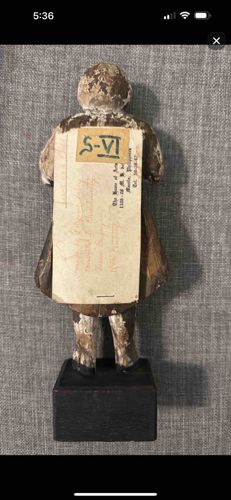
Submitted item photo
Submitted photo · June 18, 2026

User's notes

No additional notes provided.

AI analysis below

AI appraisal

AI analysis & estimate

AI-Generated · Verify before acting

Everything below is generated by AI for informational purposes only. AI can make mistakes — the AI may misidentify items or misattribute them (artist, maker, brand, designer, origin, era). This is not an official valuation and should not be used for insurance, sale, tax, estate, legal, or lending purposes — or any decision requiring a certified appraisal. It is not an authoritative claim about any person, brand, or rights holder — do not share or rely on it as a factual statement about a third party. Always consult qualified professionals before making financial decisions.

Read the full disclaimer

AI Identification

·Not independently authenticated·Verify before acting

Folk Art Carved Wooden Figure with Provenance Tag

Folk Art Sculpture

AI Estimated Value

·Not an official valuation·Verify before acting

$400 - $600

As of June 18, 2026

AI Item Analysis

·AI can make mistakes·Verify before acting
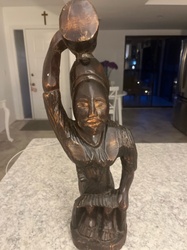
The item is a small, carved wooden figure, likely depicting a human or humanoid form, mounted on a dark, possibly wooden, rectangular base. The figure appears to be crudely carved, suggesting a folk art origin. It exhibits a highly distressed and aged surface, with significant loss of original finish or paint, revealing the raw wood beneath. The dominant colors visible are varied shades of brown and off-white/light gray, indicative of aged wood and remnants of gesso or paint. The figure's construction appears solid, with simplified anatomical features. While details of the front are not visible, the back shows a relatively flat surface where a long, rectangular paper provenance tag has been affixed. This tag is a critical feature, handwritten with 'S-VI' in a green box at the top, and further typewritten or printed details below it. Some text is partially legible: 'The House of M. H. . . .' and a numerical sequence '1130-C. M. . . . No. 39-C.' followed by more illegible text. The paper itself is aged and discolored, suggesting considerable time has passed since its attachment. The legs of the figure are visible below the tag, showing more of the distressed finish and wear. The overall condition suggests advanced age, with numerous chips, cracks, and heavy patination consistent with exposure and handling over decades, if not centuries. The craftsmanship is simple, emphasizing form over refined detail, which is characteristic of many folk art pieces. The dark base provides stability and contrasts with the lighter tones of the figure.

AI Appraisal Report

·AI can make mistakes·Verify before acting
Upon my visual examination of this Folk Art Carved Wooden Figure, I find it presents as a compelling example of its genre, likely dating to the early-to-mid 20th century, though a 19th-century origin cannot be entirely ruled out without further analysis. The piece exhibits a heavy and honest patination, with significant surface distress, finish loss, and discoloration that appear consistent with authentic age and handling. The carving is primitive and expressive, prioritizing form over anatomical accuracy, which is highly desirable in folk art collecting circles. The most significant factor impacting its value is the attached provenance tag. While partially illegible, the visible text—'S-VI', 'The House of M. H. . . .', and inventory numbers '1130-C' and 'No. 39-C'—suggests a history within a specific gallery, auction house, or collection. Identifying 'The House of M. H.' could substantially increase the figure's value by linking it to a known entity, thereby enhancing its story and desirability. The current market for authentic American or European folk art with strong decorative appeal is steady. Comparable anonymous carved figures of this size and condition typically sell in the low-to-mid hundreds. The potential of the provenance elevates this piece above the standard. However, this appraisal is limited by the inability to physically inspect the item. A definitive assessment of authenticity requires in-person examination to analyze the wood type, tool marks, and the nature of the surface wear. Furthermore, research into the provenance tag is crucial. Full authentication would benefit from wood species analysis and archival research to identify 'The House of M. H.' and trace the associated inventory numbers. Without this confirmation, the appraisal remains conservative.

Get your items appraised

Instant estimates of your treasures with AI-powered appraisals

Browse More Appraisals