AI Appraisal Estimate

AI-generated estimates · not official valuations

From the user

What was submitted

Photo and notes provided by the user — not generated by AI

Submitted item photo
Submitted photo · June 15, 2026

User's notes

1740s highboy, from Salem MA

AI analysis below

AI appraisal

AI analysis & estimate

AI-Generated · Verify before acting

Everything below is generated by AI for informational purposes only. AI can make mistakes — the AI may misidentify items or misattribute them (artist, maker, brand, designer, origin, era). This is not an official valuation and should not be used for insurance, sale, tax, estate, legal, or lending purposes — or any decision requiring a certified appraisal. It is not an authoritative claim about any person, brand, or rights holder — do not share or rely on it as a factual statement about a third party. Always consult qualified professionals before making financial decisions.

Note

This analysis also relies on unverified notes provided by the user, which may be incomplete or inaccurate and could affect the result.

Read the full disclaimer

AI Identification

·Not independently authenticated·Verify before acting

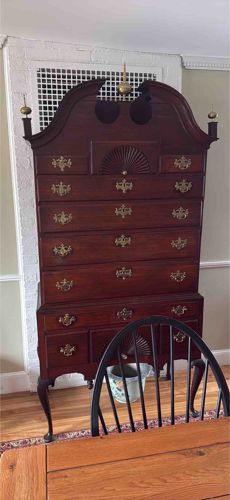
Queen Anne Bonnet-Top Highboy, Salem, Massachusetts (c. 1740s)

Antique Furniture / American Colonial

AI Estimated Value

·Not an official valuation·Verify before acting

$40,000 - $60,000

As of June 15, 2026

AI Item Analysis

·AI can make mistakes·Verify before acting
This is a quintessential example of high-style Colonial American furniture: a mid-18th-century Queen Anne high-chested highboy with a broken-arch or 'bonnet' top. Originating from Salem, Massachusetts, approximately 1740-1750, the piece is constructed primarily of mahogany or stained cherry, exhibiting the deep, rich reddish-brown patina characteristic of the period. The upper section features a fully enclosed bonnet with molded cyma curves terminating in two large, hand-carved pinwheel or fan medallions. Three turned brass finials with spiked globes sit atop the pediment. The upper case houses a central drawer with a deeply carved sunburst/fan motif, flanked by two small drawers, above four long graduated drawers. The lower case contains one long drawer over three smaller drawers, with the central bottom drawer echoing the fan carving from the top. All drawers are fitted with period-appropriate brass willow-style batwing escutcheons and bale pulls. The piece is supported by elegant cabriole legs ending in refined pad feet, a hallmark of the Queen Anne style. The apron features a scalloped, valanced design with two pendant drops. Condition appears excellent with a well-maintained finish, though naturally occurring minor abrasions to the base and feet suggest age. The craftsmanship reflects the sophisticated urban cabinetmaking traditions of Essex County, specifically seen in the proportions of the bonnet and the precision of the carved fans.
AI Appraisal Report

·AI can make mistakes·Verify before acting
This Queen Anne highboy, attributed to Salem, Massachusetts (c. 1740-1750), is a superb specimen of mid-18th-century American cabinetry. The piece exhibits the classic hallmarks of Essex County craftsmanship, particularly in the confident, broken-arch bonnet top and the twin carved fan motifs—one sunburst in the upper drawer and a matching fan in the lower apron. The mahogany secondary woods and deep, consistent patina suggest an original or very early surface, which is critical for value. The cabriole legs terminating in pad feet are graceful and well-proportioned, supporting the visual weight of the case perfectly. The brass 'willow' batwing hardware appears consistent with the period, though confirming whether it is original or a later 18th-century replacement requires inspecting the interior drawer holes. The market for high-style Colonial American furniture has softened from its peak in the early 2000s, but masterpieces from the Queen Anne period remain highly desirable. Comparables from major auction houses (Sotheby's, Christie's) for Salem highboys with similar carved fan details and bonnet tops generally hammer between $35,000 and $75,000 depending on provenance. However, a definitive valuation requires in-person inspection. I must verify the secondary woods (typically white pine for Salem) and examine the construction of the drawer dovetails to confirm the regional attribution. Crucially, 18th-century highboys often suffer from 'marriages'—where a top and bottom from two different pieces are joined. I would need to separate the cases to inspect the joining boards and color consistency to ensure they were born together. If provenance can link this piece to a known maker or family, the value could exceed the upper estimate.

Get your items appraised

Instant estimates of your treasures with AI-powered appraisals

Browse More Appraisals