These notes were written by the person who submitted this item. Appraiser.AI has not verified them, and the AI's identification and estimate may rely on them.
AI Estimated Value
Not an official valuation
$15-30
AI estimate as of August 8, 2025 · verify with a professional before acting
AI-Generated · Verify before acting
Everything on this page is generated by AI for informational purposes only. AI can make mistakes — the AI may misidentify items or misattribute them (artist, maker, brand, designer, origin, era). This is not an official valuation and should not be used for insurance, sale, tax, estate, legal, or lending purposes — or any decision requiring a certified appraisal. It is not an authoritative claim about any person, brand, or rights holder — do not share or rely on it as a factual statement about a third party. Always consult qualified professionals before making financial decisions.
This analysis also relies on unverified notes provided by the user, which may be incomplete or inaccurate and could affect the result.
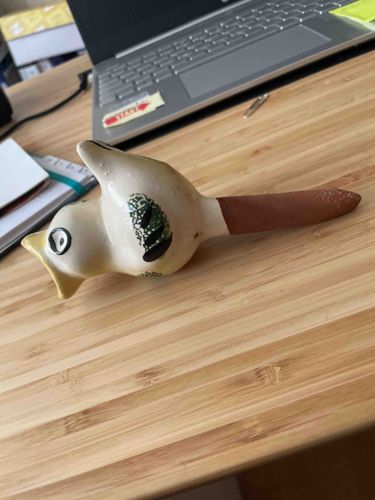
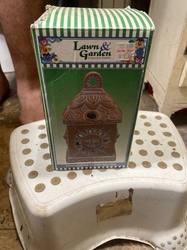
This item is a ceramic self-watering bird figurine, likely designed as a plant moisture sensor or decorative plant watering device. It measures approximately 7-8 inches in length, with a plump, rounded body and a tapering, elongated tail or spout. The primary color is an off-white or cream, finished with a smooth, glossy glaze over most of the body. The bird features painted details, including a bright yellow beak, large circular black eyes with white centers, and speckled green and black markings on its wings or back, mimicking feathers. The tail portion has an unglazed, porous, reddish-brown terracotta finish, which is characteristic of the part of the device that absorbs water. The construction appears to be molded ceramic. There are no visible chips, cracks, or significant damage, though some light surface wear or dust might be present due to typical use. The unglazed terracotta tail shows some discoloration, likely from water absorption and mineral deposits, indicating it has been used for its intended purpose. The quality of craftsmanship appears to be mass-produced, with hand-painted elements showing a reasonable degree of neatness. Without a clear maker's mark or signature, the precise manufacturing origin is unclear, but the style suggests a mid-20th century to late 20th-century aesthetic, common for novelty garden and home items. The porous nature of the tail suggests it is designed to wick water from a reservoir into a plant's soil, providing a passive watering solution. Its unique aspect lies in its dual function as both a planter ornament and a practical watering aid.
AI Appraisal Report
I have examined the provided images and descriptions of this ceramic bird-shaped self-watering spike. Based on this visual assessment, the item appears to be in good condition, consistent with its likely use. The presence of water marks and mineral deposits on the unglazed terracotta tail is expected for an item designed for water absorption and indicates it has functioned as intended. The described painted details and overall aesthetic suggest mass-produced craftsmanship, likely from the mid to late 20th century. Authenticity, based solely on images, points to it being a genuine example of a novelty self-watering device from that period.
Market conditions for such functional decorative items tend to be niche. While charming, these are generally not considered high-value collectibles. Comparable items, often found in online marketplaces or secondary markets, typically range from modest prices. Demand for such specific, vintage watering devices is moderate, driven primarily by collectors of quirky garden accessories or those seeking vintage decor. Rarity is low; many variations of these types of self-watering spikes were produced.
The primary factors impacting its value are its good condition, charming aesthetic, and functional novelty. However, its mass-produced nature and lack of a significant maker's mark limit its ceiling. For full authentication and to ascertain any hidden flaws or unique characteristics, a physical in-person examination would be beneficial. Without physical inspection, definitively ruling out hairline cracks or minor chips that are not visible in photographs, or confirming the exact ceramic composition, is not possible. Provenance documentation, such as purchase receipts or known manufacturing details, would also add to its historical and market value, though this is rarely available for such mass-produced items.