AI Appraisal Estimate

AI-generated estimates · not official valuations

From the user

What was submitted

Photo and notes provided by the user — not generated by AI

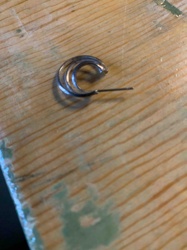
Submitted item photo
Submitted photo · June 8, 2026

User's notes

No additional notes provided.

AI analysis below

AI appraisal

AI analysis & estimate

AI-Generated · Verify before acting

Everything below is generated by AI for informational purposes only. AI can make mistakes — the AI may misidentify items or misattribute them (artist, maker, brand, designer, origin, era). This is not an official valuation and should not be used for insurance, sale, tax, estate, legal, or lending purposes — or any decision requiring a certified appraisal. It is not an authoritative claim about any person, brand, or rights holder — do not share or rely on it as a factual statement about a third party. Always consult qualified professionals before making financial decisions.

Read the full disclaimer

AI Identification

·Not independently authenticated·Verify before acting

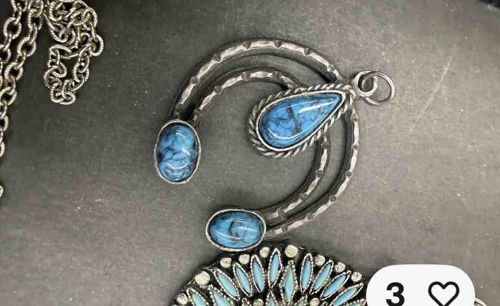
Native American Style Navajo Naja Pendant with Imitation Turquoise

Jewelry & Accessories

AI Estimated Value

·Not an official valuation·Verify before acting

$45.00 - $75.00

As of June 8, 2026

AI Item Analysis

·AI can make mistakes·Verify before acting
This item is a crescent-shaped 'Naja' pendant, a traditional motif in Navajo silversmithing often associated with squash blossom necklaces. The pendant is constructed from a double-banded metallic frame, likely silver-plated base metal or coin silver rather than high-purity sterling, given the visible surface wear and oxidation patterns. It features three inset cabochons of varying shapes: two oval stones at the terminal ends of the crescent and a teardrop-shaped stone suspended in the center. The stones exhibit a bright blue hue with heavy black matrix veining; however, the uniform texture and surface luster suggest they are likely stabilized turquoise or more probably a synthetic resin/howlite imitation rather than high-grade natural turquoise. The teardrop setting is highlighted by a twisted wire rope border, a common decorative element in Southwestern jewelry. The metalwork shows notches or stampings along the outer curve for added texture. Condition-wise, the piece shows significant dark tarnish (patina) and surface scratches consistent with age and use. The jump ring at the top appears slightly misshapen, indicating wear from a heavy chain. There are no visible maker's marks or hallmark stamps in the provided image, suggesting it may be a mid-20th-century tourist trade piece or a modern costume reproduction of the classic Southwestern style.
AI Appraisal Report

·AI can make mistakes·Verify before acting
I have conducted a visual examination of the crescent-shaped Navajo-style Naja pendant. The piece is characteristic of 'Tourist Trade' jewelry produced in the mid-to-late 20th century. My analysis suggests the metal is likely silver-plated brass or a low-grade 'nickel silver' alloy, evidenced by the specific oxidation patterns and the lack of a '925' or sterling hallmark. The three inset cabochons display a high degree of uniformity in color and matrix distribution, which is strongly indicative of stabilized howlite or resin-based imitation turquoise rather than genuine turquoise. The construction utilizes standard decorative elements such as the twisted wire 'rope' border and hand-stamped notches. While these techniques mimic authentic Navajo smithing, the overall execution points to mass production or apprentice-level work meant for the souvenir market. The current market for such costume pieces is healthy but saturated. Comparable items on secondary platforms typically realize prices under $100. Factors limiting value include the absence of a maker’s mark, the use of non-precious materials, and the moderate wear on the jump ring. Crucially, as this appraisal is based solely on digital images, I cannot definitively confirm its composition. To provide a final valuation, an in-person examination is required to conduct a streak or acid test on the metal and a thermal conductivity/refractive index test on the stones. Provenance documentation, such as original sales receipts from a known trading post, would be necessary to elevate its status above that of a contemporary reproduction.

Get your items appraised

Instant estimates of your treasures with AI-powered appraisals

Browse More Appraisals