AI estimate as of August 27, 2025 · verify with a professional before acting
AI-Generated · Verify before acting
Everything on this page is generated by AI for informational purposes only. AI can make mistakes — the AI may misidentify items or misattribute them (artist, maker, brand, designer, origin, era). This is not an official valuation and should not be used for insurance, sale, tax, estate, legal, or lending purposes — or any decision requiring a certified appraisal. It is not an authoritative claim about any person, brand, or rights holder — do not share or rely on it as a factual statement about a third party. Always consult qualified professionals before making financial decisions.
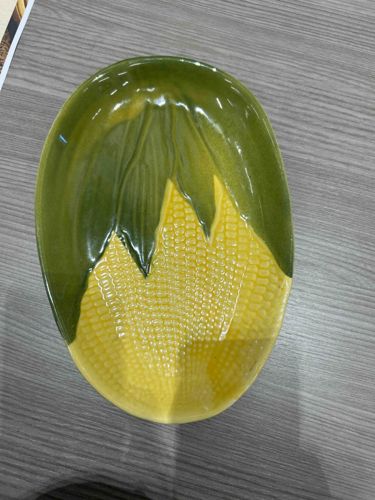
This item is an oval-shaped ceramic serving dish or platter, designed to resemble an ear of corn. It measures approximately 12-14 inches in length and 8-10 inches in width and has a shallow depth, characteristic of a serving platter. The dish features a vibrant color palette, with the upper portion glazed in a rich, glossy dark green, transitioning into a bright, sunny yellow for the lower and central sections. The green area is molded to mimic the husks of corn, with raised veins and folds to suggest their texture. The yellow section is meticulously textured with a raised, cross-hatched pattern, simulating individual corn kernels on the cob, giving it a realistic and tactile appearance. The glaze has a high sheen, indicating proper firing and a smooth, non-porous surface, typical of earthenware or stoneware. No visible chips, cracks, or significant wear are apparent in the provided image, suggesting it is in good to excellent condition. There are no discernible maker's marks or signatures visible from this angle. This type of whimsical, fruit or vegetable-themed pottery became popular in the mid-20th century, suggesting an estimated age from the 1950s to 1980s. The craftsmanship appears to be of good quality, with clear detailing and consistent glazing, although it is likely a mass-produced item rather than a unique artisan piece. Its unique design makes it suitable for decorative purposes or for serving corn-on-the-cob, hot dishes, or appetizers.
AI Appraisal Report
Upon examining the provided image of this Majolica Style Corn Serving Platter, I assess its condition to be good to excellent. The glazes show high sheen, detailing is clear, and there are no visible chips, cracks, or significant wear. This indicates careful use and storage. Authenticity, based solely on visual inspection, places it within the mid-20th century, likely 1950s-1980s, consistent with the described whimsical, themed pottery trends. While the craftsmanship is good, the lack of maker's marks and the consistent, uniform appearance suggest it is a mass-produced item rather than a singular artisan piece, which impacts its rarity and, consequently, its value.
Market conditions for such novelty dinnerware are generally steady but not robust. Comparables often sell in the low-to-mid range for vintage decorative serveware. Demand for this specific corn motif is niche but consistent among collectors of themed kitchenware or vintage ceramic pieces. The item's primary value drivers are its unique aesthetic, good condition, and potential for both decorative display and practical use. Its mass-produced nature prevents it from commanding high prices.
It is crucial to note that authentication limitations exist when relying solely on images. Without physical inspection, I cannot verify the exact type of ceramic body (earthenware vs. stoneware), detect subtle hairline cracks or repairs, or examine the base for hidden maker's marks or firing imperfections. A hands-on examination would allow for tactile assessment of texture, weight, and a thorough inspection for any signs of damage or restoration not visible in photographs. Provenance documentation, though unlikely for an item of this nature, would further solidify its history. Scientific testing, such as thermoluminescence dating, would be excessive and unnecessary for an item of this probable age and typical value range.