Framed Delft-Style Hand-Painted Ceramic Tile
Decorative Arts / Ceramics

Framed Delft-Style Hand-Painted Ceramic Tile

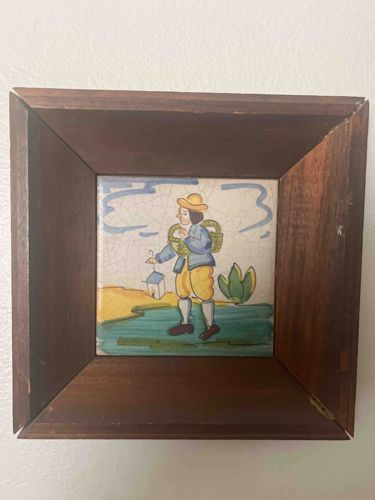
This item is a square ceramic art tile, likely of European origin—possibly Dutch or Portuguese—featuring a hand-painted scene of a rustic male figure. The figure is depicted in traditional folk attire, wearing a wide-brimmed yellow hat, a blue jacket, yellow breeches, and carrying two baskets across his back with a lantern in his right hand. The background includes simplified landscape elements such as yellow hills, green ground, and blue stylized clouds. The tile is set within a heavy, dark-toned wide-profile wooden frame with mitered corners. Physically, the tile exhibits significant all-over 'crazing' (fine surface cracking of the glaze), which is often an indicator of age or specific kiln-firing techniques. The color palette is composed of primary and secondary tones: blue, yellow, green, and brown against a cream-colored glazed ground. The painting style is naive and folk-inspired, with visible brushstrokes and black outlining common in 19th or early 20th-century decorative tiles. Regarding condition, the wooden frame shows several signs of wear including gaps at the mitered joints, particularly at the bottom right and top left, along with minor scuffs and surface scratches. The tile itself appears intact without large chips or structural cracks, though the pervasive crazing suggests it may date from the late 1800s to the mid-20th century. No maker's marks or signatures are visible on the front; such marks would likely be located on the reverse side of the ceramic biscuit, currently obscured by the frame backing.

Estimated Value

$150-$250

Basic Information

Category

Decorative Arts / Ceramics

Appraised On

March 28, 2026

Estimated Value

$150-$250

Item Description

This item is a square ceramic art tile, likely of European origin—possibly Dutch or Portuguese—featuring a hand-painted scene of a rustic male figure. The figure is depicted in traditional folk attire, wearing a wide-brimmed yellow hat, a blue jacket, yellow breeches, and carrying two baskets across his back with a lantern in his right hand. The background includes simplified landscape elements such as yellow hills, green ground, and blue stylized clouds. The tile is set within a heavy, dark-toned wide-profile wooden frame with mitered corners. Physically, the tile exhibits significant all-over 'crazing' (fine surface cracking of the glaze), which is often an indicator of age or specific kiln-firing techniques. The color palette is composed of primary and secondary tones: blue, yellow, green, and brown against a cream-colored glazed ground. The painting style is naive and folk-inspired, with visible brushstrokes and black outlining common in 19th or early 20th-century decorative tiles. Regarding condition, the wooden frame shows several signs of wear including gaps at the mitered joints, particularly at the bottom right and top left, along with minor scuffs and surface scratches. The tile itself appears intact without large chips or structural cracks, though the pervasive crazing suggests it may date from the late 1800s to the mid-20th century. No maker's marks or signatures are visible on the front; such marks would likely be located on the reverse side of the ceramic biscuit, currently obscured by the frame backing.
Get Your Items Appraised

Instant estimates of your treasures with AI-powered instant appraisals

Browse More Appraisals