Perforated Lapis Lazuli or Sodalite Stone Bead
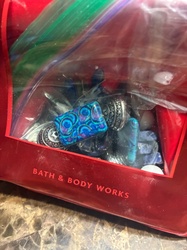
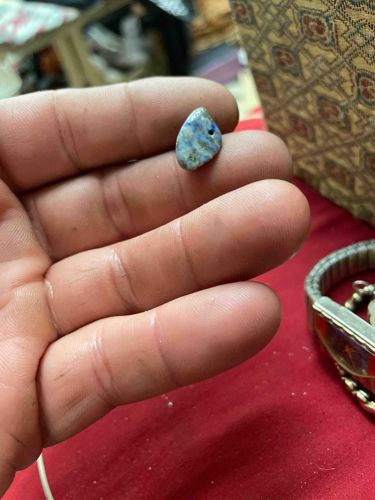
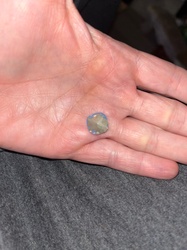
This small, approximately 1cm long semi-precious stone bead exhibits an irregular, organic teardrop or almond shape. The material appears to be either lapis lazuli or sodalite, characterized by a deep cobalt blue base heavily mottled with white to light-tan calcite inclusions and possibly pyrite flecks. A single, off-center perforation is visible near the narrower apex, suggesting its function as a pendant or a focus bead for a necklace or bracelet. The stone features a tumble-polished finish that retains some natural surface pits and geological undulations rather than a perfectly smooth cabochon cut. Its condition shows signs of age-related wear, including softened edges and a matte patina on the surface, which deviates from the high-gloss shine found in modern machine-polished stones. There are no visible maker's marks or signatures, which is typical for small lithic components. Based on the primitive drilling and irregular polishing style, it likely dates from the mid-20th century or earlier, potentially originating from an artisanal or ethnographic jewelry piece from Central Asia or the American Southwest. The charm of the piece lies in its rustic, handcrafted quality and the natural variance of the mineral patterns.
AI-Generated Appraisal Disclaimer
Estimated Value
$10 - $25
Basic Information
Category
Jewelry Components / Gemstones
Appraised On
December 24, 2025
Estimated Value
$10 - $25
Item Description
This small, approximately 1cm long semi-precious stone bead exhibits an irregular, organic teardrop or almond shape. The material appears to be either lapis lazuli or sodalite, characterized by a deep cobalt blue base heavily mottled with white to light-tan calcite inclusions and possibly pyrite flecks. A single, off-center perforation is visible near the narrower apex, suggesting its function as a pendant or a focus bead for a necklace or bracelet. The stone features a tumble-polished finish that retains some natural surface pits and geological undulations rather than a perfectly smooth cabochon cut. Its condition shows signs of age-related wear, including softened edges and a matte patina on the surface, which deviates from the high-gloss shine found in modern machine-polished stones. There are no visible maker's marks or signatures, which is typical for small lithic components. Based on the primitive drilling and irregular polishing style, it likely dates from the mid-20th century or earlier, potentially originating from an artisanal or ethnographic jewelry piece from Central Asia or the American Southwest. The charm of the piece lies in its rustic, handcrafted quality and the natural variance of the mineral patterns.
Get Your Items Appraised
Instant estimates of your treasures with AI-powered instant appraisals