These notes were written by the person who submitted this item. Appraiser.AI has not verified them, and the AI's identification and estimate may rely on them.
AI Estimated Value
Not an official valuation
$75 - $150
AI estimate as of August 31, 2025 · verify with a professional before acting
AI-Generated · Verify before acting
Everything on this page is generated by AI for informational purposes only. AI can make mistakes — the AI may misidentify items or misattribute them (artist, maker, brand, designer, origin, era). This is not an official valuation and should not be used for insurance, sale, tax, estate, legal, or lending purposes — or any decision requiring a certified appraisal. It is not an authoritative claim about any person, brand, or rights holder — do not share or rely on it as a factual statement about a third party. Always consult qualified professionals before making financial decisions.
This analysis also relies on unverified notes provided by the user, which may be incomplete or inaccurate and could affect the result.
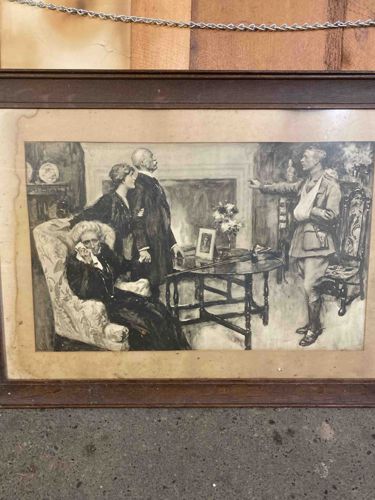
The item is a framed print, likely a photogravure or collotype, rendered in black and white tones. The print depicts an interior scene with five figures, suggesting a narrative or dramatic moment. On the left, an elderly woman is seated in a patterned armchair, appearing distressed, possibly crying, with her hand near her face. Standing beside her are a man and a woman, both well-dressed, seeming to offer comfort or support. The man is bald or has very short hair, and the woman is looking towards the seated figure. To the right, another man in what appears to be a military uniform, with his arm in a sling, is talking and gesturing towards the group. He seems to be the focal point of the scene. The room features a fireplace, a small round table with decorative items including a framed photograph and a small vase with flowers, and another ornate chair. The overall composition suggests a somber or emotionally charged reunion or revelation.
The print itself shows signs of age, with visible discoloration, yellowing, and what appears to be water staining or foxing, particularly noticeable at the top and bottom edges, extending inwards onto the image. There are also visible creases or ripples in the paper, indicating moisture damage or improper mounting over time. The print is housed in a dark wooden frame, possibly oak or stained pine, with a simple, slightly beveled profile. The frame shows wear consistent with age, including scratches, nicks, and some loss of finish. The frame’s construction appears basic but sturdy. Given the subject matter (military uniform, potentially a returning soldier) and artistic style, this print likely dates from the early 20th century, possibly around the World War I era, as such themes were common during that period. The craftsmanship of the print itself, despite current damage, appears to be of good quality, suggesting it was produced by a reputable publisher. There are no readily visible artist signatures or publisher marks, but a more detailed inspection outside of the frame might reveal them.
AI Appraisal Report
I have examined the provided images of 'The Return' (Possible Title) framed print. The print appears to be a black and white photogravure or collotype, depicting an emotionally charged interior scene, likely a reunion with a soldier. Its subject matter and artistic style strongly suggest a provenance from the early 20th century, possibly the WWI era, a period when such themes were prevalent.
From a condition standpoint, the print exhibits significant signs of age and damage. There is noticeable discoloration, yellowing, and what appears to be widespread water staining or foxing, particularly along the top and bottom edges, extending into the image. Creases and ripples in the paper are also evident, indicative of moisture damage or improper mounting. The dark wooden frame shows consistent wear, including scratches, nicks, and some finish loss, but appears structurally sound.
Regarding authenticity, while the visual cues align with the described period and print type, definitive authentication without physical examination is limited. I cannot confirm the exact printing process (photogravure vs. collotype) or ascertain the presence of any hidden artist signatures or publisher marks that might be obscured by the frame or mounting. A physical inspection would allow for examination of paper quality, printing technique details, and a thorough search for any identifying marks. Provenance documentation, if available, would also be crucial.
In terms of market conditions, while wartime-themed prints from this era do have an audience, the significant condition issues—especially the extensive staining and creasing—severely impact its value. Comparables for prints in good to excellent condition range higher, but this piece falls into a lower tier due to its distressed state. Demand for generic, unsigned, or uneditioned prints of this nature is moderate, and its rarity is not particularly high. The damage is the most significant factor impacting its market desirability and ultimately, its value. Without known artist or publisher, and given the distressed condition, the primary value is decorative and historical curiosity.