Petrified Wood Celt (Hand Axe Lithic Specimen)
Archaeological Artifacts & Lithics

Petrified Wood Celt (Hand Axe Lithic Specimen)

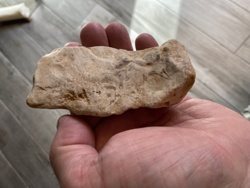
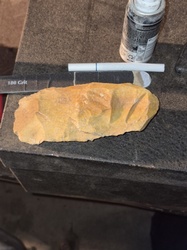
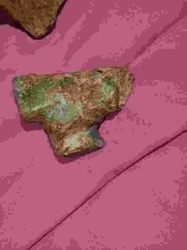
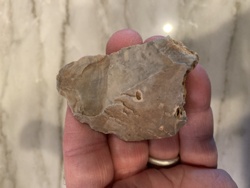
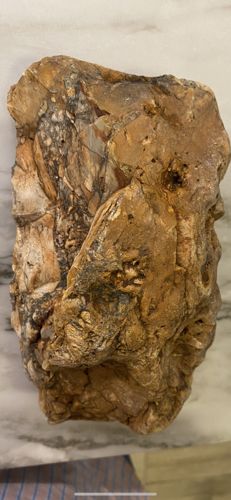
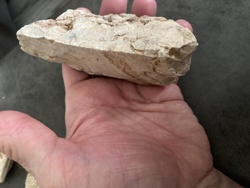
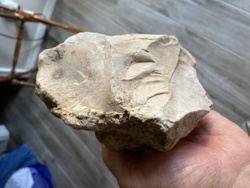
This specimen is a large lithic object measuring approximately 8 inches by 4 inches, discovered in Guthrie, Oklahoma. It is composed of petrified wood, a material formed during the permineralization process where organic wood is replaced by silicate minerals, most likely quartz or chalcedony in this instance. The surface exhibits a varied color palette dominated by earth tones, including ochre, sienna, and mahogany browns, interspersed with grey and cream-colored mineral deposits. The visible grain and texture characteristic of the original timber are still discernible under the silicified surface. In terms of construction, the piece shows evidence of potential anthropogenic modification, which would categorize it as a 'celt' or hand tool. One end appears tapered, suggesting use as a chopping or scraping implement. The surface displays a natural patina with varying degrees of smoothness and rougher, porous areas where mineralization was less uniform. There are several conchoidal fractures and chips visible on the edges, which could be the results of intentional knapping (flaking) by prehistoric inhabitants or natural environmental weathering. The material is dense and heavy, indicating high-quality silicification which would make it a durable substrate for tool making. There are no modern maker's marks, signifying its origin as an ancient artifact or a naturally occurring geofact. The condition is consistent with an object of extreme antiquity, showing no modern fractures but significant ancient wear patterns across its surface.

Estimated Value

$400 - $650

Basic Information

Category

Archaeological Artifacts & Lithics

Appraised On

February 17, 2026

Estimated Value

$400 - $650

Additional Details Provided By Owner

User Provided Information

Found this prehistoric petrified wood multi tool celt in Guthrie, OK. It measures 8"x 4" and is a beautiful stone

Item Description

This specimen is a large lithic object measuring approximately 8 inches by 4 inches, discovered in Guthrie, Oklahoma. It is composed of petrified wood, a material formed during the permineralization process where organic wood is replaced by silicate minerals, most likely quartz or chalcedony in this instance. The surface exhibits a varied color palette dominated by earth tones, including ochre, sienna, and mahogany browns, interspersed with grey and cream-colored mineral deposits. The visible grain and texture characteristic of the original timber are still discernible under the silicified surface. In terms of construction, the piece shows evidence of potential anthropogenic modification, which would categorize it as a 'celt' or hand tool. One end appears tapered, suggesting use as a chopping or scraping implement. The surface displays a natural patina with varying degrees of smoothness and rougher, porous areas where mineralization was less uniform. There are several conchoidal fractures and chips visible on the edges, which could be the results of intentional knapping (flaking) by prehistoric inhabitants or natural environmental weathering. The material is dense and heavy, indicating high-quality silicification which would make it a durable substrate for tool making. There are no modern maker's marks, signifying its origin as an ancient artifact or a naturally occurring geofact. The condition is consistent with an object of extreme antiquity, showing no modern fractures but significant ancient wear patterns across its surface.
Get Your Items Appraised

Instant estimates of your treasures with AI-powered instant appraisals

Browse More Appraisals