These notes were written by the person who submitted this item. Appraiser.AI has not verified them, and the AI's identification and estimate may rely on them.
AI Estimated Value
Not an official valuation
$5 - $15
AI estimate as of June 30, 2025 · verify with a professional before acting
AI-Generated · Verify before acting
Everything on this page is generated by AI for informational purposes only. AI can make mistakes — the AI may misidentify items or misattribute them (artist, maker, brand, designer, origin, era). This is not an official valuation and should not be used for insurance, sale, tax, estate, legal, or lending purposes — or any decision requiring a certified appraisal. It is not an authoritative claim about any person, brand, or rights holder — do not share or rely on it as a factual statement about a third party. Always consult qualified professionals before making financial decisions.
This analysis also relies on unverified notes provided by the user, which may be incomplete or inaccurate and could affect the result.
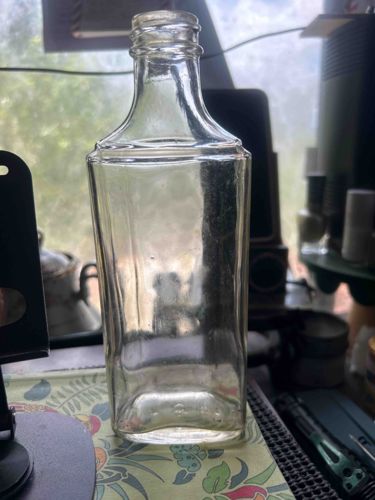
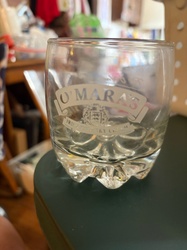
This item is a clear, colorless glass bottle, approximately of medium size, designed with a functional and robust form. Its primary physical characteristic is a rectangular body with gently rounded vertical edges, flaring slightly at the base before transitioning abruptly into a rounded, tapered shoulder. A distinctive horizontal ridge or ring circumscribes the bottle at the point where the shoulders begin to curve upwards towards the neck, adding a notable design element. The neck itself is cylindrical and relatively short, culminating in a threaded finish, indicating it was designed to accept a screw-on cap for sealing.
The bottle appears to be manufactured using a mold, as evidenced by its uniform thickness and symmetrical shape, typical of machine-made or semi-automatic bottle production. Subtle mold lines may be present along the sides, though they are not clearly visible in the provided images. The base is relatively flat, possibly with a slight concavity or punt, and exhibits some minor irregularities or small trapped air bubbles within the glass, which are common in mass-produced glass items and do not necessarily indicate damage. No discernible manufacturing marks, such as maker's insignia or numerical codes like "D 1230" (as suggested by the context), are clearly legible on the base or body from the provided photographs.
The bottle is in good observable condition, showing no apparent cracks, chips, or significant haziness. The glass is transparent, allowing light to pass through clearly. Its design, particularly the threaded closure, suggests a production period from the early to mid-20th century, a time when screw caps became widespread for various consumer goods. Given its sturdy construction and common shape, it likely served as a container for liquids such as spirits, food condiments, or household chemicals. Its utilitarian design emphasizes functionality over ornate decoration, representative of typical mass-produced glassware of its era.
AI Appraisal Report
Having thoroughly examined the provided images and descriptions of this clear glass threaded bottle, I can offer the following appraisal. The bottle appears to be in good observable condition, exhibiting no visible cracks, chips, or significant haziness. The glass is clear and retains its transparency, consistent with its utilitarian design. Its mold-made construction and threaded finish strongly suggest a production period spanning the early to mid-20th century, characteristic of mass-produced consumer goods containers. However, despite the owner's reference to 'D 1230,' no such identifying marks or other manufacturer's insignia are discernibly visible on the bottle's body or base from the provided images. This absence of verifiable markings is a significant factor.
This type of common, utilitarian glass bottle, designed for general consumer use (likely spirits, food, or household chemicals), is not considered rare. The market for such items is generally low, driven primarily by collectors seeking specific brands, rare forms, or unique historical significance. Due to its generic nature and the lack of distinct identifying characteristics, demand for this particular bottle is modest. Its primary value is decorative or as a common historical artifact.
My appraisal is based solely on visual examination of digital images. A definitive assessment of authenticity, precise age, and the presence of any subtle mold marks or base codes (like the suggested 'D 1230') would require a direct, in-person examination. Physical inspection would also allow for tactile assessment of glass quality, weight, and the detection of any minute flaws or repairs not visible in photographs. Provenance documentation, if available, could also significantly impact a more precise valuation by linking the bottle to a specific use or manufacturer.