AI Appraisal Estimate

AI-generated estimates · not official valuations

From the user

What was submitted

Photo and notes provided by the user — not generated by AI

Submitted item photo
Submitted photo · May 16, 2026

User's notes

No additional notes provided.

AI analysis below

AI appraisal

AI analysis & estimate

AI-Generated · Verify before acting

Everything below is generated by AI for informational purposes only. AI can make mistakes — the AI may misidentify items or misattribute them (artist, maker, brand, designer, origin, era). This is not an official valuation and should not be used for insurance, sale, tax, estate, legal, or lending purposes — or any decision requiring a certified appraisal. It is not an authoritative claim about any person, brand, or rights holder — do not share or rely on it as a factual statement about a third party. Always consult qualified professionals before making financial decisions.

Read the full disclaimer

AI Identification

·Not independently authenticated·Verify before acting

Japanese Satsuma-style Decorative Vase

Fine Art Ceramics and Porcelain

AI Estimated Value

·Not an official valuation·Verify before acting

$150-$250

As of May 16, 2026

AI Item Analysis

·AI can make mistakes·Verify before acting
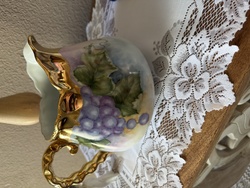
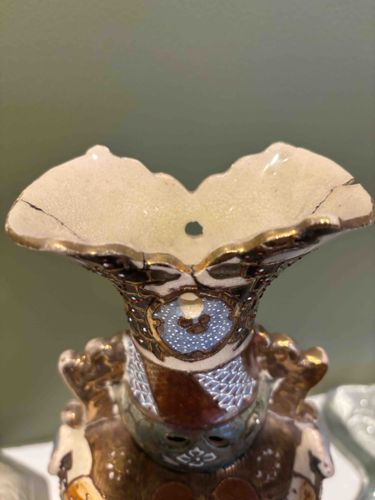
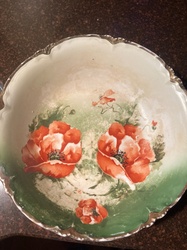
This is a detailed Japanese Satsuma-style porcelain or earthenware decorative vase, likely dating from the late 19th century (Meiji period) to the early 20th century. The piece features a highly ornate flared rim with a scalloped, quatrefoil-inspired edge and a constricted neck leading into a bulbous body with applied decorative handles. The construction material is a dense ceramic, visible through significant crazing on the internal cream-colored glaze. The exterior is richly decorated with 'moriage' (raised enamel) techniques and heavy gold gilding. Colors include a palette of burnt orange, cobalt blue, and earthy greens, set against intricate geometric patterns such as 'asa-no-ha' (hemp leaf) and fish scale motifs. Notable features include small circular perforations or 'air holes' in the neck and body, possibly intended for incense or as part of a multi-piece assembly. The condition is significantly compromised, showing multiple structural cracks running vertically from the rim down into the neck, along with some glaze loss and wear to the gilding. These visible fractures suggest a high degree of fragility and previous impact damage. The craftsmanship is typical of Export Satsuma ware, designed for Western markets, focusing on dense, complex surface ornamentation rather than minimalist traditional Japanese aesthetics.
AI Appraisal Report

·AI can make mistakes·Verify before acting
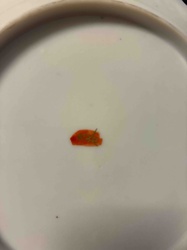
Upon visual examination of this Japanese Satsuma-style earthenware vase, I have identified it as an export-ware piece dating from the late Meiji period (circa 1900-1912). The vessel displays characteristic moriage raised-enamel decoration and heavy gilding typical of the Kyoto workshops catering to Western tastes. While the decorative motifs, including the geometric 'asa-no-ha' patterns and textured enameling, demonstrate respectable craftsmanship for the period, the item's value is severely mitigated by its condition. I observed significant structural vertical fractures extending from the flared rim into the neck, which represent terminal damage for ceramic collectors. Furthermore, visible glaze loss and wear to the gilt highlights suggest improper storage or handling. In the current market, collectors prioritize 'mint' specimens of Satsuma; damaged pieces typically lose 70-80% of their potential 'fair market' value. While the size and ornate handles provide some decorative appeal, it remains a common export form rather than a rare signed piece by a master like Kinkozan or Yabu Meizan. Note: This assessment is based solely on digital imagery. A definitive identification of the kiln or artist signature (missing or obscured here) would require a physical inspection of the base. To fully authenticate the age beyond a visual estimation of the crazing, an in-person examination would be necessary to rule out mid-20th-century 'Satsuma-style' reproductions. Provenance documentation or a professional cleaning to reveal hidden marks would be required for a more rigorous valuation.

Get your items appraised

Instant estimates of your treasures with AI-powered appraisals

Browse More Appraisals