Early American Pattern Glass (EAPG) Two-Handled Open Sugar Bowl
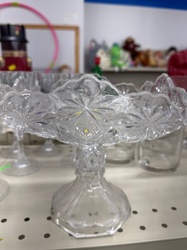
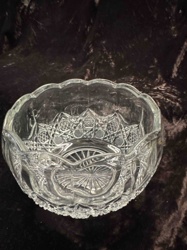
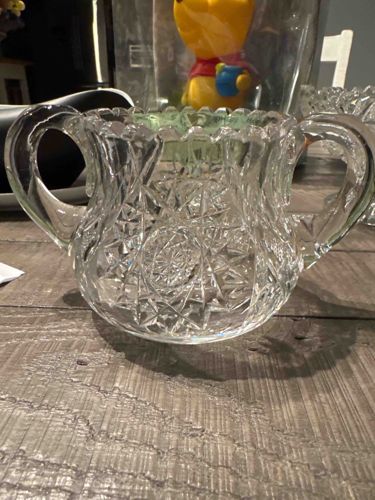
This is an antique or vintage two-handled open sugar bowl made of pressed clear glass, commonly referred to as Early American Pattern Glass (EAPG). The item features a bulbous body that tapers slightly toward a scalloped 'sawtooth' rim. Its primary decorative scheme consists of a 'Pinwheel' or 'Whirling Star' pattern, characterized by deep geometric incisions and hobstar motifs that create a high-refraction effect, mimicking the look of more expensive hand-cut crystal. Two curved, 'ear-shaped' handles are fused to the sides, designed for a comfortable grip. The glass exhibits the typical weight and clarity associated with late 19th or early 20th-century American manufacturing. Though no specific maker's mark is visible in the photograph (which is common for this type of glassware), the style is consistent with the output of companies like Imperial Glass or L.E. Smith from the Early 1900s. The condition appears to be excellent for its age, showing no significant chips, cracks, or clouding (sickness), though minor surface scratches on the base and slight mold seams characteristic of factory production are likely present under closer inspection. The sharp edges of the pattern indicate a well-maintained mold, which is a key indicator of quality for pattern glass collectors.
AI-Generated Appraisal Disclaimer
Estimated Value
$45.00 - $65.00
Basic Information
Category
Antique Glassware / Collectible Tableware
Appraised On
March 20, 2026
Estimated Value
$45.00 - $65.00
Item Description
This is an antique or vintage two-handled open sugar bowl made of pressed clear glass, commonly referred to as Early American Pattern Glass (EAPG). The item features a bulbous body that tapers slightly toward a scalloped 'sawtooth' rim. Its primary decorative scheme consists of a 'Pinwheel' or 'Whirling Star' pattern, characterized by deep geometric incisions and hobstar motifs that create a high-refraction effect, mimicking the look of more expensive hand-cut crystal. Two curved, 'ear-shaped' handles are fused to the sides, designed for a comfortable grip. The glass exhibits the typical weight and clarity associated with late 19th or early 20th-century American manufacturing. Though no specific maker's mark is visible in the photograph (which is common for this type of glassware), the style is consistent with the output of companies like Imperial Glass or L.E. Smith from the Early 1900s. The condition appears to be excellent for its age, showing no significant chips, cracks, or clouding (sickness), though minor surface scratches on the base and slight mold seams characteristic of factory production are likely present under closer inspection. The sharp edges of the pattern indicate a well-maintained mold, which is a key indicator of quality for pattern glass collectors.
Related Tags
Explore similar items and categories:
Get Your Items Appraised
Instant estimates of your treasures with AI-powered instant appraisals