AI estimate as of July 16, 2025 · verify with a professional before acting
AI-Generated · Verify before acting
Everything on this page is generated by AI for informational purposes only. AI can make mistakes — the AI may misidentify items or misattribute them (artist, maker, brand, designer, origin, era). This is not an official valuation and should not be used for insurance, sale, tax, estate, legal, or lending purposes — or any decision requiring a certified appraisal. It is not an authoritative claim about any person, brand, or rights holder — do not share or rely on it as a factual statement about a third party. Always consult qualified professionals before making financial decisions.
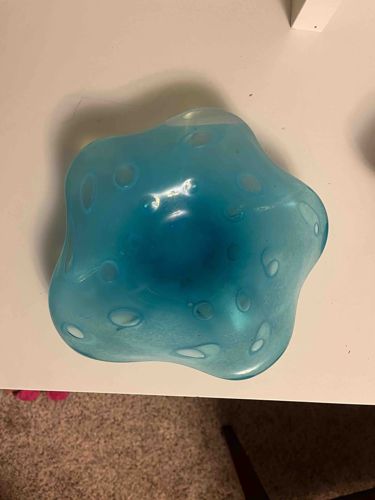
This is a freeform, possibly hand-blown, art glass bowl, characterized by its organic, undulating shape which departs from traditional symmetrical forms. The primary color is a vibrant turquoise blue, transitioning to a deeper blue in the center, suggesting varying thickness of glass or a concentrated color application. A striking feature is the inclusion of numerous 'sommerso' or 'bullicante' effect air bubbles, which are trapped within the layers of glass, creating a distinctive pattern of light-colored, circular inclusions scattered across the surface. These bubbles are irregularly sized and positioned, adding to the artisanal quality. The surface appears glossy and smooth, typical of polished glass. The form suggests a mid-20th century or later origin, aligning with art glass movements that embraced abstract and organic shapes. There are no visible chips, cracks, or significant abrasions from the provided image, suggesting good overall condition. No discernible maker's marks or signatures are visible, which is common for some types of art glass or studio pieces. The craftsmanship appears to be of good quality, given the smooth finish and successful embedding of the bubbles, indicating skill in glassblowing techniques.
AI Appraisal Report
Upon visual examination of the provided image, this Turquoise Blue Organic Art Glass Bowl presents in excellent condition. I observe no chips, cracks, or significant abrasions, which speaks to careful handling. Its freeform, undulating shape and vibrant turquoise transitioning to deeper blue, coupled with the 'bullicante' effect of segregated bubbles, confirm it as a distinctive piece of art glass. The glossy, smooth finish further suggests quality craftsmanship.
Authenticity, based solely on an image, is assessed on design characteristics. This piece aligns with mid-20th century to contemporary art glass movements known for embracing abstract forms and internal bubble effects, often associated with Murano or studio glass artists. However, without a maker's mark or signature, definitive attribution to a specific artist or studio is impossible from images alone. This absence is common for many studio pieces.
Market conditions for decorative art glass remain relatively stable, with demand for unique, well-executed pieces. Comparable contemporary and vintage art glass bowls with similar organic forms and 'bullicante' features often fetch prices ranging depending on size, artist recognition, and provenance. The lack of provenance or a known maker limits the top-tier valuation but does not negate its aesthetic and decorative value.
Factors significantly impacting value include its excellent condition, appealing color, and the intricate bubble work. The primary limitation in authenticity verification from an image is the inability to conduct a physical inspection for internal flaws, weight, pontil marks (if applicable), or precise material analysis. For full authentication and a more precise valuation, I would require in-person examination to assess the glass quality, examine the base for any faint markings or a ground pontil, and potentially utilize scientific testing if there were suspicions about its age or origin (e.g., lead content analysis for older glass). Provenance documentation, such as purchase receipts or exhibition history, would also be invaluable.