AI estimate as of July 4, 2025 · verify with a professional before acting
AI-Generated · Verify before acting
Everything on this page is generated by AI for informational purposes only. AI can make mistakes — the AI may misidentify items or misattribute them (artist, maker, brand, designer, origin, era). This is not an official valuation and should not be used for insurance, sale, tax, estate, legal, or lending purposes — or any decision requiring a certified appraisal. It is not an authoritative claim about any person, brand, or rights holder — do not share or rely on it as a factual statement about a third party. Always consult qualified professionals before making financial decisions.
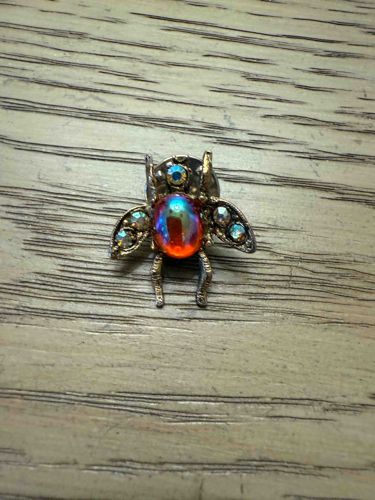
This item is a vintage-style insect-shaped brooch or pin, likely depicting a bee or similar flying insect, crafted from a base metal with a somewhat aged or tarnished appearance, suggesting brass, copper, or a similar alloy with a bronze-like patina. The central body of the insect is adorned with a prominent, oval-shaped cabochon stone that exhibits strong iridescence, shifting in color from a fiery orange-red at its center to blues and purples at its edges, characteristic of an Aurora Borealis (AB) coated glass stone or possibly a synthetic opal. Surrounding this central stone, and forming the wings and head of the insect, are several smaller, faceted clear or pale blue rhinestones, set within individual bezels or prongs. Two small antennae protrude from the head section. The legs of the insect are rendered in a stylized fashion, extending downwards and slightly outwards. The overall size appears to be relatively small, consistent with a lapel pin or small brooch, likely less than 2 inches in its largest dimension. The craftsmanship suggests it is a mass-produced piece from the mid-to-late 20th century, possibly 1950s-1980s, given the use of AB rhinestones which were popular during that era. There are no obvious signs of significant damage like missing stones or bent parts from the visible side, but the metal shows some wear and oxidation consistent with age and use, contributing to its vintage aesthetic. The quality of stone setting appears to be standard for costume jewelry of its period.
AI Appraisal Report
Upon examining the provided image of this vintage iridescent stone insect brooch, I can assess its condition as good vintage with typical signs of age. The metal exhibits a characteristic patina consistent with brass or copper from the mid-to-late 20th century. The central holographic cabochon, likely an AB-coated glass stone or synthetic opal, retains its vibrant iridescence. All visible smaller rhinestones appear to be intact and possess their original sparkle, set in a manner standard for costume jewelry of the era. Authenticity, based solely on the visual, points to a genuine vintage mass-produced costume piece from the 1950s-1980s, aligning with the popular use of AB rhinestones during that period. I see no immediate indicators of it being a modern reproduction. Market conditions for vintage costume jewelry, particularly insect motifs, remain relatively stable. Comparables would include similar unsigned insect brooches from brands like Coro, Monet, or unsigned pieces with similar stone qualities. Demand is modest but consistent among collectors of vintage costume jewelry. Rarity is low; these types of pieces were mass-produced. Factors impacting value include the lack of a designer signature, the common materials used (base metal, glass, rhinestones), and its overall condition which, while good vintage, is not pristine. The primary value drivers are its aesthetic appeal and the charm of its vintage nature. Without an in-person examination, I cannot definitively verify the material composition of the central stone (e.g., true synthetic opal vs. coated glass) or ascertain any maker's marks or hidden damage. A physical inspection would also allow for a tactile assessment of craftsmanship, pin mechanism integrity, and precise dimensions. Provenance documentation would add significant value, but is rarely available for such items. Scientific testing, like spectroscopic analysis, would be needed for definitive material identification, but is generally not economically viable for costume jewelry of this value range.