AI estimate as of November 10, 2025 · verify with a professional before acting
AI-Generated · Verify before acting
Everything on this page is generated by AI for informational purposes only. AI can make mistakes — the AI may misidentify items or misattribute them (artist, maker, brand, designer, origin, era). This is not an official valuation and should not be used for insurance, sale, tax, estate, legal, or lending purposes — or any decision requiring a certified appraisal. It is not an authoritative claim about any person, brand, or rights holder — do not share or rely on it as a factual statement about a third party. Always consult qualified professionals before making financial decisions.
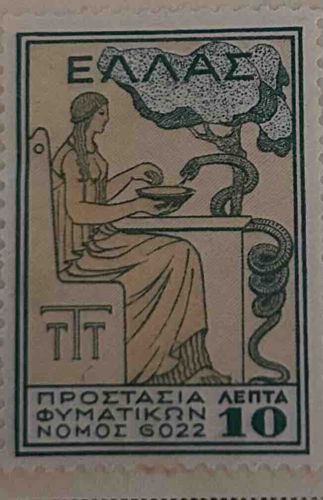
This item is a historical Greek postage stamp, likely issued as a charitable revenue stamp, specifically for the 'Tuberculosis Protection' fund. The stamp features a central vignette depicting a seated female figure, possibly Hygieia, the Greek goddess of health, holding a patera (shallow bowl) from which a serpent, often associated with Asclepius (god of medicine), is feeding. To her right, a gnarled tree or plant is visible, and the serpent is intricately coiled around its trunk or a stand. The design style is simplistic yet evocative, reminiscent of classical Greek art with a more modern, illustrative touch, suggesting a period between the early to mid-20th century. The colors are predominantly green and light brown/khaki, providing a somewhat muted and serious tone appropriate for its charitable purpose. The top border of the stamp reads 'ΕΛΛΑΣ' (ELLAS), identifying it as Greek. At the bottom, in Greek text, are the phrases 'ΠΡΟΣΤΑΣΙΑ ΛΕΠΤΑ' (Protection Lepta) 'ΦΥΜΑΤΙΚΩΝ' (Tuberculosis) and 'ΝΟΜΟΣ 6022' (Law 6022), indicating its function and the legal basis for its issuance. The denomination '10' is prominently displayed in the lower right corner, likely representing 10 Lepta. To the left of the seated figure, there are two intertwined 'T's, possibly a monogram or an abbreviation related to the issuing body or cause. The stamp has perforations along its edges, typical for postage or revenue stamps, though the image provided shows small sections of the original paper around the perforations, suggesting it might be mint or part of a block. The visible condition appears good, with clear printing and no apparent major tears, creases, or significant discoloration. The paper itself seems to be off-white or cream-colored. The overall craftsmanship suggests a professionally printed item, likely produced by the national printing office or a reputable private firm.
AI Appraisal Report
I have examined the provided image of the Greek Tuberculosis Charitable Stamp, 10 Lepta. Based on this visual inspection, the stamp appears to be in very fine condition. The design elements are crisp, and the colors—predominantly green and light brown/khaki—are well-preserved with no apparent significant fading or discoloration. The perforations are intact, and there are no visible tears, creases, or major flaws, suggesting it may be a mint example or very lightly hinged. The printing quality seems consistent with official issues of the period. The 'ΕΛΛΑΣ' (Greece) at the top and the 'ΠΡΟΣΤΑΣΙΑ ΦΥΜΑΤΙΚΩΝ' (Tuberculosis Protection) text, along with the denomination '10', are clearly legible, authenticating it as a legitimate Greek charity stamp, likely from the early to mid-20th century, specifically referencing Law 6022.
In terms of market conditions, Greek charitable and revenue stamps, while collectible, generally do not command the same high values as definitive or commemorative postage stamps, unless they are extremely rare varieties or errors. Comparables for similar Greek charitable issues in very fine to superb condition typically fall within a modest range. Demand is primarily from specialist collectors of Greek philately or those focusing on health-related or war charity issues. Its rarity is moderate; these stamps were issued in significant quantities for public sale.
Factors impacting value positively are its excellent apparent condition and clear identification. Negative factors include its charitable rather than standard postage status, which often reduces broad collector interest. Without physical inspection, I cannot definitively assess gum condition, specific paper variations, or confirm that it is truly mint. For full authentication and a more precise valuation, an in-person examination is crucial to assess gum, paper type, watermarks (if any), and to rule out any repairs or subtle flaws not visible in the image. Provenance documentation could further enhance its value, especially if it was part of a renowned collection.