AI estimate as of September 9, 2025 · verify with a professional before acting
AI-Generated · Verify before acting
Everything on this page is generated by AI for informational purposes only. AI can make mistakes — the AI may misidentify items or misattribute them (artist, maker, brand, designer, origin, era). This is not an official valuation and should not be used for insurance, sale, tax, estate, legal, or lending purposes — or any decision requiring a certified appraisal. It is not an authoritative claim about any person, brand, or rights holder — do not share or rely on it as a factual statement about a third party. Always consult qualified professionals before making financial decisions.
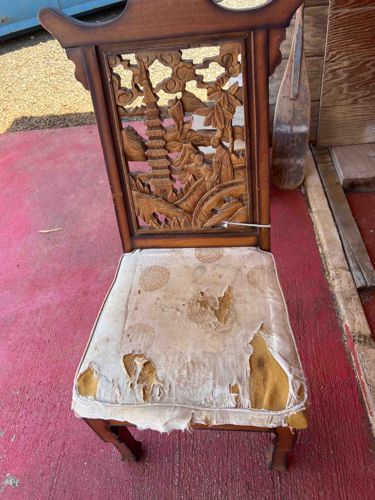
This is a single wooden side chair, likely crafted from a dark-toned hardwood, possibly teak or a similar durable wood, given its apparent age and style. The chair features an elaborate, openwork carved backrest depicting a detailed East Asian-inspired landscape scene. Visible elements in the carving include a multi-tiered pagoda, stylized clouds, foliage, and what appears to be human figures or mythological creatures within the natural setting. The carving demonstrates skillful craftsmanship with varying depths and textures, suggesting either hand-carving or machine carving finished by hand. The chair's frame has a dark, reddish-brown stain or finish, which shows some wear and minor scratches consistent with age and use. The top of the backrest features a decorative, flared, and slightly scrolled design. The seat is upholstered with a cushion, which is in very poor condition. The light-colored fabric of the cushion is severely torn and degraded, revealing the yellowed padding or underlying fabric beneath. The original fabric appears to have a subtle patterned motif, possibly a brocade or jacquard, though its deteriorated state makes clear identification difficult. The legs of the chair are dark and relatively simple, with what appears to be a slight curve or shaping at the bottom. No specific maker's marks or signatures are visible in the image. Based on the style of carving and overall construction, the chair appears to be from the mid-20th century, possibly dating back to the 1950s-1970s, reflecting a period when East Asian aesthetics were popular in Western furniture design. The quality of the carving indicates good craftsmanship, though the overall condition, particularly the highly damaged upholstery, significantly impacts its presentability and immediate usability.
AI Appraisal Report
I have examined the provided image of this East Asian Style Carved Wooden Side Chair. This chair, likely crafted from a dark-toned hardwood, features an elaborate openwork carved backrest depicting an East Asian-inspired landscape with a pagoda, clouds, and figures. The craftsmanship evident in the carving is good, suggesting either skilled hand-carving or machine finishing. The overall style points to a mid-20th century production, likely 1950s-1970s, reflecting the popularity of Asian aesthetics during that period.
Condition-wise, the wooden frame shows typical wear, minor scratches, and a reddish-brown finish consistent with age and use. However, the most significant factor affecting its value is the extremely poor condition of the upholstered seat cushion. The fabric is severely torn and degraded, revealing underlying padding, which significantly diminishes its presentability and usability without restoration.
In terms of market conditions, while there is a consistent, albeit modest, demand for well-preserved mid-century furniture with unique decorative elements, the extensive upholstery damage severely impacts this chair's immediate marketability. Comparables for similar carved chairs in good condition might fetch higher prices, but this piece would require an investment in professional reupholstery, which can often exceed the chair's current value. Its rarity is not exceptionally high for this style period.
Limitations in authenticity verification are inherent when appraising from images alone. Without physical inspection, I cannot ascertain the precise wood type, the exact carving method (hand vs. machine-finished), or the presence of any hidden maker's marks or structural issues. A hands-on examination would allow for tactile assessment of the carving depth, stability of joints, and detailed inspection of the wood grain and finish. Provenance documentation, such as original sales receipts or family history, would also be invaluable for confirming origin and age. My appraisal reflects its condition based solely on visual evidence.