AI Appraisal Estimate

AI-generated estimates · not official valuations

From the user

What was submitted

Photo and notes provided by the user — not generated by AI

Submitted item photo
Submitted photo · June 10, 2026

User's notes

No additional notes provided.

AI analysis below

AI appraisal

AI analysis & estimate

AI-Generated · Verify before acting

Everything below is generated by AI for informational purposes only. AI can make mistakes — the AI may misidentify items or misattribute them (artist, maker, brand, designer, origin, era). This is not an official valuation and should not be used for insurance, sale, tax, estate, legal, or lending purposes — or any decision requiring a certified appraisal. It is not an authoritative claim about any person, brand, or rights holder — do not share or rely on it as a factual statement about a third party. Always consult qualified professionals before making financial decisions.

Read the full disclaimer

AI Identification

·Not independently authenticated·Verify before acting

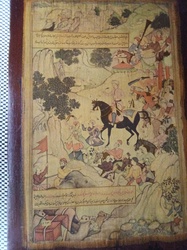
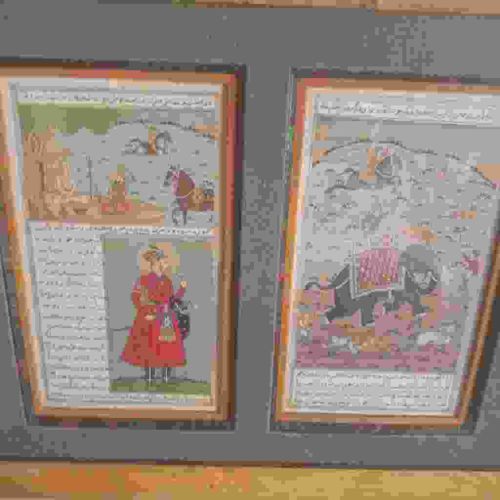
Diptych of Mughal/Indo-Persian Manuscript Miniature Paintings

Asian Art / Antique Manuscripts & Paintings

AI Estimated Value

·Not an official valuation·Verify before acting

$400 - $700

As of June 10, 2026

AI Item Analysis

·AI can make mistakes·Verify before acting
This item consists of two individual manuscript pages, presented as a diptych within a modern dark grey mount. The miniatures are executed in the tradition of Mughal or Indo-Persian school painting, likely dating from the late 19th to early 20th century, though styled after 17th-century historical court art. Each page features handwritten Nasta'liq script—a cursive style of Persian calligraphy—surrounding central pictorial scenes. The left panel features a standing noble figure in a red jama (tunic) and a hunt/encampment scene above. The right panel depicts a ceremonial elephant with a red howdah moving through a landscape. The colors include prominent reds, earthy ochres, and muted greens, applied using opaque pigments on paper. The craftsmanship suggests a commercial or 'bazaar' style intended for collectors, mimicking royal illumination. Notable features include the integrated text-to-image layout typical of literary epics like the Shahnama. Regarding condition, there is visible fading of the pigments, slight yellowing and foxing of the paper consistent with age, and some minor abrasion to the painted surfaces. The works are housed in simple wooden frames. While no specific maker's signature is visible in this resolution, the composition follows strict stylistic conventions of South Asian courtly miniature art.
AI Appraisal Report

·AI can make mistakes·Verify before acting
I have carefully examined the provided images of this diptych containing two Indo-Persian manuscript pages. The works are executed in the Mughal revival style, most likely dating from the early 20th century. Based on the stylistic conventions of the Nasta'liq script and the simplified palettes, these pieces align with 'bazaar' productions—high-quality commercial works created for the export market and private collectors rather than 17th-century royal court workshops. The condition shows age-appropriate foxing and minor pigment abrasion, which adds to the aesthetic charm but confirms their status as late-period historical recreations. The market for South Asian miniatures remains active, with high demand for early period works (16th-18th century). However, late 19th and early 20th-century examples like these are valued primarily as decorative objects or entry-level collectibles. Comparables for such 'bazaar' pieces typically realize between $200 and $400 per leaf at auction. The diptych presentation and the presence of the ceremonial elephant motif—a popular subject—provide a slight premium in valuation. Factors impacting value include the lack of a known artist's signature and the use of modern framing. Furthermore, visual analysis alone cannot definitively confirm the age of the ink or the chemical composition of the pigments. To fully authenticate these pieces as earlier historical works, an in-person examination of the paper’s fiber and watermarking is required, along with provenance documentation tracing the acquisition back several decades. Scientific testing (micro-spectroscopy) would be necessary to identify any modern chemical binders that might distinguish these from period originals. My valuation reflects their current status as high-quality historical revival curiosities.

Get your items appraised

Instant estimates of your treasures with AI-powered appraisals

Browse More Appraisals