Antique Indo-Portuguese Style Carved Teak Sideboard
Antique Furniture / Accent Cabinets

Antique Indo-Portuguese Style Carved Teak Sideboard

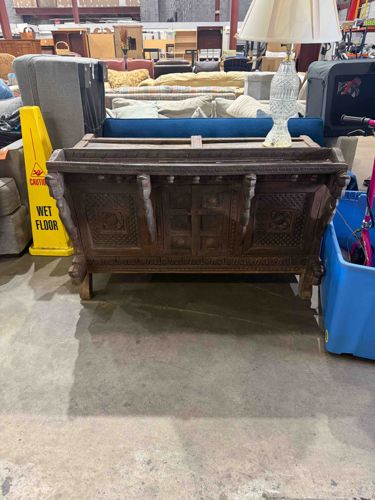
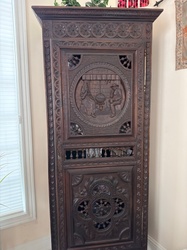
This is a substantial, highly ornate console or sideboard, likely originating from India and executed in an Indo-Portuguese or colonial provincial style. The piece is constructed from a dark, dense wood, possibly teak or sheesham, finished with a dark brown stain. It features extensive hand-carving across the entire front facade, including three distinct panels. The central panel appears to be a small double-door cabinet, while the flanking panels are decorated with deep geometric recesses and floral rosettes. The top surface is recessed with a raised gallery edge, suggesting it may have originally functioned as a dry sink or a chest for specific household goods. A notable architectural feature is the series of four prominent corbels or carved brackets that support the overhanging top rail, punctuated by teardrop-shaped finials hanging below. The legs are integrated into the side stiles, terminating in short, blocked feet with slight shaping at the base. The craftsmanship displays traditional joinery techniques, though it shows significant signs of age and wear. There is visible surface distress, including scuffs to the lower carvings, dust accumulation in the deep recessed areas, and a dry patina that suggests the wood would benefit from conditioning. The overall style is reminiscent of 19th-century or early 20th-century colonial furniture characterized by heavy proportions and dense ornamentation.
Estimated Value

$1,800 - $2,500

Basic Information

Category

Antique Furniture / Accent Cabinets

Appraised On

January 10, 2026

Estimated Value

$1,800 - $2,500

Item Description

This is a substantial, highly ornate console or sideboard, likely originating from India and executed in an Indo-Portuguese or colonial provincial style. The piece is constructed from a dark, dense wood, possibly teak or sheesham, finished with a dark brown stain. It features extensive hand-carving across the entire front facade, including three distinct panels. The central panel appears to be a small double-door cabinet, while the flanking panels are decorated with deep geometric recesses and floral rosettes. The top surface is recessed with a raised gallery edge, suggesting it may have originally functioned as a dry sink or a chest for specific household goods. A notable architectural feature is the series of four prominent corbels or carved brackets that support the overhanging top rail, punctuated by teardrop-shaped finials hanging below. The legs are integrated into the side stiles, terminating in short, blocked feet with slight shaping at the base. The craftsmanship displays traditional joinery techniques, though it shows significant signs of age and wear. There is visible surface distress, including scuffs to the lower carvings, dust accumulation in the deep recessed areas, and a dry patina that suggests the wood would benefit from conditioning. The overall style is reminiscent of 19th-century or early 20th-century colonial furniture characterized by heavy proportions and dense ornamentation.
Get Your Items Appraised

Instant estimates of your treasures with AI-powered instant appraisals

Browse More Appraisals