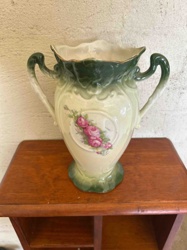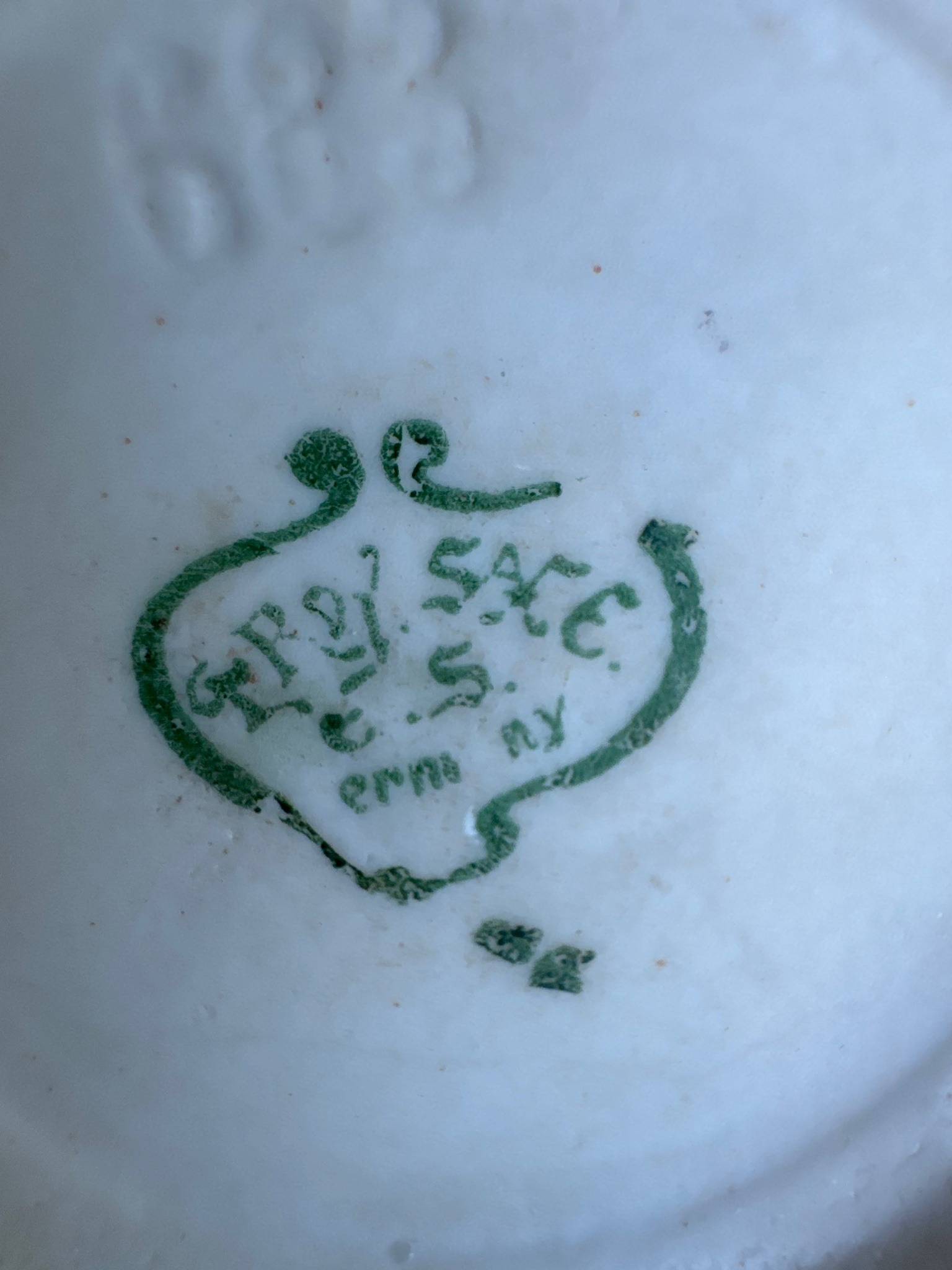
Royal Saxe E.S. Germany Porcelain Backstamp
This image displays the underglaze backstamp found on a piece of antique porcelain, identifying it as a product of the Erphila (Eberthal) factory, specifically under the 'Royal Saxe' brand name. The mark corresponds to Erdmann Schlegelmilch of Suhl, Prussia (later Germany), indicated by the 'E.S.' initials. The stamp is executed in a deep forest green pigment and features the text 'ROYAL SAXE' above 'E.S.' and 'germany' contained within a decorative, scrolling cartouche. Additionally, there is a distinct impressed numerical mark '683' visible in the porcelain body above the green stamp, which typically indicates a mold or shape number. The porcelain itself appears as a high-quality, translucent white hard-paste body. Condition-wise, there are several small brown iron spots or 'firing specks'—impurities in the clay common in older porcelain—along with some minor surface grime and faint localized crazing or pitting in the glaze. This mark was primarily used during the late 19th century to early 20th century (circa 1891-1910) for items intended for export to the American market. The inclusion of 'Germany' in lowercase suggests a production date post-1891 following the McKinley Tariff Act. The craftsmanship is indicative of standard European export-grade decorative arts of the Victorian/Edwardian era.

AI-Generated Appraisal Disclaimer
Estimated Value
$45–$85
Basic Information
Category
Antique Ceramics and Porcelain
Appraised On
May 12, 2026
Estimated Value
$45–$85
Item Description
This image displays the underglaze backstamp found on a piece of antique porcelain, identifying it as a product of the Erphila (Eberthal) factory, specifically under the 'Royal Saxe' brand name. The mark corresponds to Erdmann Schlegelmilch of Suhl, Prussia (later Germany), indicated by the 'E.S.' initials. The stamp is executed in a deep forest green pigment and features the text 'ROYAL SAXE' above 'E.S.' and 'germany' contained within a decorative, scrolling cartouche. Additionally, there is a distinct impressed numerical mark '683' visible in the porcelain body above the green stamp, which typically indicates a mold or shape number. The porcelain itself appears as a high-quality, translucent white hard-paste body. Condition-wise, there are several small brown iron spots or 'firing specks'—impurities in the clay common in older porcelain—along with some minor surface grime and faint localized crazing or pitting in the glaze. This mark was primarily used during the late 19th century to early 20th century (circa 1891-1910) for items intended for export to the American market. The inclusion of 'Germany' in lowercase suggests a production date post-1891 following the McKinley Tariff Act. The craftsmanship is indicative of standard European export-grade decorative arts of the Victorian/Edwardian era.
Get Your Items Appraised
Instant estimates of your treasures with AI-powered instant appraisals