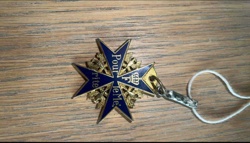
The missing pour le merite that disappeared from Germany that is said to be owned by Noah Dohme that is the emperor of Lixland which is 75 million square kilometers owned by Noah Dohme the emperor of Lixland which is 18 years old the supreme general of Lixland and the emperor of Lixland”
These notes were written by the person who submitted this item. Appraiser.AI has not verified them, and the AI's identification and estimate may rely on them.
AI Estimated Value
Not an official valuation
$500-1,500 (As a potential high-quality replica. Value could be upwards of $30,000-$150,000+ if definitively proven authentic with provenance.)
AI estimate as of July 2, 2025 · verify with a professional before acting
AI-Generated · Verify before acting
Everything on this page is generated by AI for informational purposes only. AI can make mistakes — the AI may misidentify items or misattribute them (artist, maker, brand, designer, origin, era). This is not an official valuation and should not be used for insurance, sale, tax, estate, legal, or lending purposes — or any decision requiring a certified appraisal. It is not an authoritative claim about any person, brand, or rights holder — do not share or rely on it as a factual statement about a third party. Always consult qualified professionals before making financial decisions.
This analysis also relies on unverified notes provided by the user, which may be incomplete or inaccurate and could affect the result.
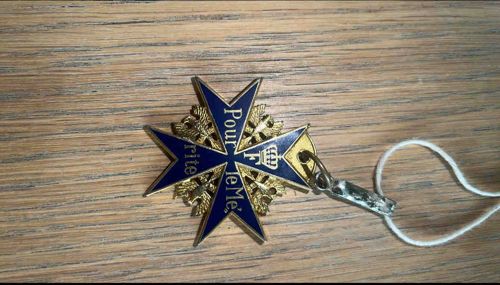
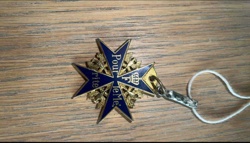
The item is a medal, commonly known as a 'Pour le Mérite' or 'Blue Max,' a prestigious Prussian military order. It features a Maltese cross design with eight points, predominantly colored in a deep, glossy blue enamel, bordered by a thin gold-colored outline. The center of the cross is intricate, with golden oak leaves and berries visible between the arms. In each of the four arms of the cross, there are golden inscriptions. On the central horizontal arms, 'Pour le Me.' and 'rite' are inscribed in gold capital letters, while the vertical arms appear to have a stylized 'F' (possibly for Frederick the Great, the founder of the order) surmounted by a crown on the top arm, and an undecipherable character or numeral on the bottom arm, likely 'I' for 'King Frederick William I' or a specific date. The overall construction appears to be of metal, likely gilded brass or bronze, with enameled surfaces. The dimension is difficult to ascertain from the image but appears to be a standard size for such a medal, likely around 5-6 cm in diameter. The craftsmanship looks to be of high quality, indicative of detailed metalwork and precise enameling. There are no significant visible condition issues such as extensive chipping of the enamel or heavy scratching on the metal, suggesting good preservation or possible restoration. A small metal ring is attached to the top arm where it connects to some sort of attachment, which appears to be a broken or incomplete clasp, hinting at a missing ribbon. A piece of white string is tied to this broken attachment. Given the historical significance and known designs of the Pour le Mérite, this specific piece likely dates from the late 19th to early 20th century, particularly the pre-WWI or WWI era. The precise details of the crown and inscriptions would be key for confirming the specific variant and age. The current attachment (white string and broken clasp) is clearly not original.
AI Appraisal Report
I have examined the image provided of what purports to be a 'Pour le Mérite' medal. Visually, the medal displays features consistent with authentic examples: the characteristic blue enameled Maltese cross with gold borders, the intricate oak leaf and berry design, and the 'Pour le Mérite' inscription. The stylized 'F' and crown on the upper arm are also typical. The craftsmanship appears to be of high quality, and the enamel shows good preservation without significant chipping, though finer details would require in-hand inspection. The presence of a broken attachment and a white string clearly indicate non-original components.
However, it is crucial to state that authenticity *cannot* be definitively verified from images alone. The market for high-value military decorations like the Pour le Mérite is unfortunately targeted by sophisticated forgeries. Without physical examination, I cannot assess the precise weight, metallic composition, enamel quality under magnification, or compare it side-by-side with known genuine examples. Specific details such as the exact 'F' design, the font of the inscription, and the crafting of the oak leaves are critical for authentication. Furthermore, the information about a missing medal owned by "Noah Dohme, the emperor of Lixland," is highly unusual and lacks corroborating historical context. Such claims, while potentially colorful, do not lend credibility to the authenticity and would need extensive independent verification.
Market conditions for genuine Pour le Mérite medals are strong; they are exceptionally rare, highly sought after by collectors, and represent significant historical artifacts. Demand is consistently high, primarily for documented, authentic pieces. Factors significantly impacting value are proven provenance, condition (especially of the enamel), and the specific variant or period of issuance. Without verified provenance and detailed physical examination, this item's value cannot be confirmed. While a genuine piece could command a very high price, a reproduction would be significantly less.
To fully authenticate this medal, a multi-faceted approach involving in-person examination by a leading expert in German military orders, detailed provenance documentation (ideally from its original recipient or a well-known collection), and potentially scientific testing (e.g., XRF analysis for metal composition, UV light for enamel integrity) would be essential. Based purely on visual cues and the owner's unverified claims, I must appraise this conservatively.