AI Appraisal Estimate

AI-generated estimates · not official valuations

From the user

What was submitted

Photo and notes provided by the user — not generated by AI

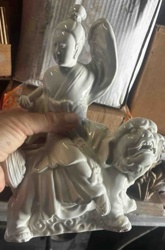
Submitted item photo
Submitted photo · June 30, 2026

User's notes

No additional notes provided.

AI analysis below

AI appraisal

AI analysis & estimate

AI-Generated · Verify before acting

Everything below is generated by AI for informational purposes only. AI can make mistakes — the AI may misidentify items or misattribute them (artist, maker, brand, designer, origin, era). This is not an official valuation and should not be used for insurance, sale, tax, estate, legal, or lending purposes — or any decision requiring a certified appraisal. It is not an authoritative claim about any person, brand, or rights holder — do not share or rely on it as a factual statement about a third party. Always consult qualified professionals before making financial decisions.

Read the full disclaimer

AI Identification

·Not independently authenticated·Verify before acting

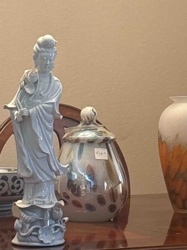
Japanese Satsuma-Style Gilt Porcelain Baluster Vase

Asian Art & Antiquities - Ceramics

AI Estimated Value

·Not an official valuation·Verify before acting

$45-85

As of June 30, 2026

AI Item Analysis

·AI can make mistakes·Verify before acting
This is a decorative porcelain vase in the Satsuma style, featuring a classic baluster form with a flared rim and a pedestal-style foot. The piece is heavily ornamented with 'moriage' (raised enamel) techniques and extensive gilding. The primary design consists of dense floral patterns, including peonies and chrysanthemums, in a rich palette of iron-red, cobalt blue, and green over a dark, textured charcoal-black background. A prominent feature is the pair of gilded dimensional lion-head handles (shishi) holding fixed rings positioned on the neck. The central body features a framed cartouche containing what appears to be a landscape or character scene, bordered by delicate gold beading. The construction suggests it is a mid-to-late 20th-century ceramic export, possibly from the Showa era, rather than an antique Meiji-period piece. In terms of condition, there is visible wear to the gilding on the rim and lion-head handles, along with characteristic light crazing in the glaze. The base shows a geometric decorative band typical of mass-produced Satsuma revival wares. No maker's mark is visible from this angle, but the quality of the application suggests factory-controlled craftsmanship intended for the decorative export market.
AI Appraisal Report

·AI can make mistakes·Verify before acting
I have conducted a visual inspection of this Satsuma-style baluster vase. The item is identified as a mid-to-late 20th-century decorative export piece, likely manufactured in the Showa-era (post-WWII) or by a contemporary workshop for the mass market. While it employs traditional motifs such as shishi (lion-dog) handles and moriage enameling, the application is consistent with factory-produced 'Satsuma-revival' wares rather than the refined, hand-enameled craftsmanship of the Meiji-period Kyoto or Satsuma kofun masterworks. The condition exhibits moderate shelf wear, notably the thinning of the gilding on high-contact points like the rim and handles. The crazing observed is typical for the porous earthenware bodies used in these replicas. In the current secondary market, supply for mid-century export ceramics significantly exceeds demand. Similar items are frequently traded at local estate sales and online auctions, where they serve as decorative accents rather than investment-grade collectibles. The lack of a specific artist's mark and the simplified geometric borders further indicate a commercial origin. Critically, a definitive valuation is limited by the digital nature of this inspection. A physical examination is necessary to check for hair-line cracks, professional restorations invisible in photographs, and to weigh the density of the ceramic body—a key indicator of age. Verification of authenticity would require inspecting the base for specific maker stamps and researching provenance documentation. Without evidence of a known master studio, the value remains in the decorative category.

Get your items appraised

Instant estimates of your treasures with AI-powered appraisals

Browse More Appraisals