AI Appraisal Estimate

AI-generated estimates · not official valuations

From the user

What was submitted

Photo and notes provided by the user — not generated by AI

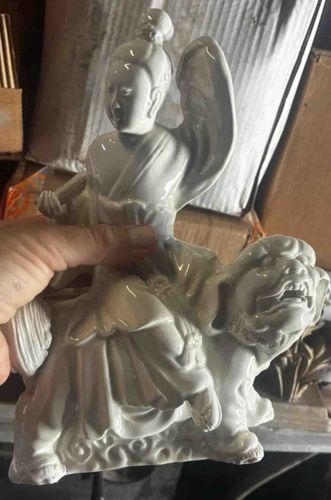
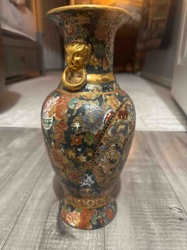
Submitted item photo
Submitted photo · June 25, 2026

User's notes

No additional notes provided.

AI analysis below

AI appraisal

AI analysis & estimate

AI-Generated · Verify before acting

Everything below is generated by AI for informational purposes only. AI can make mistakes — the AI may misidentify items or misattribute them (artist, maker, brand, designer, origin, era). This is not an official valuation and should not be used for insurance, sale, tax, estate, legal, or lending purposes — or any decision requiring a certified appraisal. It is not an authoritative claim about any person, brand, or rights holder — do not share or rely on it as a factual statement about a third party. Always consult qualified professionals before making financial decisions.

Read the full disclaimer

AI Identification

·Not independently authenticated·Verify before acting

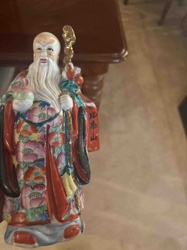
Dehua Blanc de Chine Figurine of Manjushri on a Shishi

Asian Art & Antiquities - Ceramics

AI Estimated Value

·Not an official valuation·Verify before acting

$250 - $400

As of June 25, 2026

AI Item Analysis

·AI can make mistakes·Verify before acting
This is a white glazed porcelain figurine, commonly referred to as Blanc de Chine or Dehua ware, depicting a Buddhist deity, likely Manjushri (Wenshu Pusa), seated atop a Shishi (guardian lion or Foo Dog). The piece features a high-gloss monochromatic creamy white glaze characteristic of mid-to-late 20th-century Dehua production. The human figure is shown in traditional flowing robes with a topknot hairstyle, holding what appears to be a scroll. The Shishi underneath is depicted with a wide, open-mouthed snarl, stylized curly mane, and detailed musculature. The craftsmanship shows standard mold-poured characteristics with some manual finishing in the finer drapery folds and facial features. Structurally, the piece stands approximately 8 to 10 inches tall. The condition appears fair to good, with no immediately visible large cracks, though fine crazing or minor firing defects are common in such porcelain. There is some visible surface grime and dust consistent with long-term storage. The base is likely unglazed, which is typical for this style. This specific aesthetic suggests a mid-20th century export piece imitating the classic Ming or Qing dynasty styles originating from the Fujian province.
AI Appraisal Report

·AI can make mistakes·Verify before acting
I have virtually examined this Dehua (Blanc de Chine) porcelain figure of Manjushri seated upon a Shishi. This piece displays the characteristic 'creamy white' glaze and translucent body associated with Fujian province production. While it pays homage to 17th-century Ming prototypes, the technical execution—specifically the sharpness of the mold lines and the uniform consistency of the glaze—indicates a mid-20th-century export production (circa 1950-1970). The figure exhibits standard craftsmanship for this era; the drapery is stylized but lacks the fluid, hand-carved depth found in early Dehua wares. The Shishi's features are expressive, though the glaze pooling in the recesses suggests modern dipping techniques rather than historical brush application. Current market demand for mid-century Chinese export porcelain remains stable, though prices are significantly lower than for period Ming or Qing examples. Comparables for mid-20th-century Dehua figures of this size typically hammer at boutique auctions between $200 and $500 depending on the level of detail and presence of maker marks (such as the He Chaozong seal, which is often apocryphal on later pieces). It is important to note that a definitive valuation is limited by the digital nature of this inspection. A physical examination is required to check for micro-chips, professional restorations, and to inspect the base for specific kiln grit or marks. Specifically, viewing the interior paste under UV light and confirming provenance documentation would be necessary to rule out a late Qing attribution, which could significantly increase the valuation.

Get your items appraised

Instant estimates of your treasures with AI-powered appraisals

Browse More Appraisals