AI estimate as of November 1, 2025 · verify with a professional before acting
AI-Generated · Verify before acting
Everything on this page is generated by AI for informational purposes only. AI can make mistakes — the AI may misidentify items or misattribute them (artist, maker, brand, designer, origin, era). This is not an official valuation and should not be used for insurance, sale, tax, estate, legal, or lending purposes — or any decision requiring a certified appraisal. It is not an authoritative claim about any person, brand, or rights holder — do not share or rely on it as a factual statement about a third party. Always consult qualified professionals before making financial decisions.
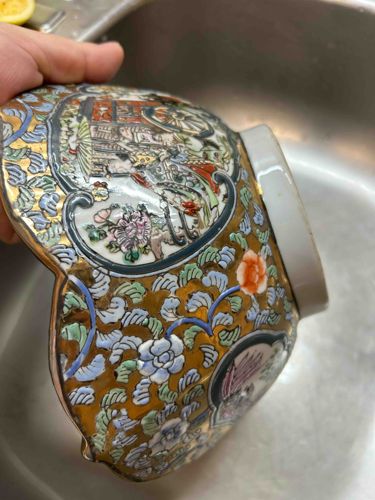
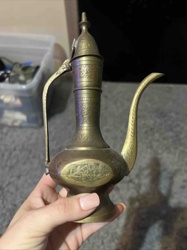
This appears to be a Japanese Imari-style ceramic vessel, possibly a teapot given the visible opening on the right, though a handle and spout are not visible in the provided image. The item features a bulbous, somewhat asymmetrical form, suggesting it is not perfectly round. Its primary colors are a rich, lustrous gold background, vibrant oranges, blues, greens, pinks, and whites, accented with black outlines. The surface is heavily decorated with an intricate pattern. One prominent section within a curvilinear cartouche depicts a detailed landscape scene with what appears to be traditional Japanese architecture, possibly a pagoda or temple, and figures - suggesting a narrative or genre scene. Below this, and continuing around the body, are floral motifs including peonies and other blossoms, interspersed with scrolling foliage. The gold areas are adorned with a meticulously rendered 'brocade' pattern, often seen in Imari ware, adding to its opulent feel. The craftsmanship indicates hand-painting, with fine brushwork evident in the detailed designs. The overall condition appears good, with no obvious chips or cracks visible, although some light surface wear or patina might be present on the gold-gilt areas due to age and handling. The rim of the opening on the right side is clean and white, indicating a well-finished edge. The item likely dates from the late 19th to early 20th century, consistent with the popularity and stylistic elements of Imari porcelain produced for export. The dense ornamentation and use of gold are hallmarks of this decorative style, often associated with a high degree of artistry and labor.
AI Appraisal Report
Based on my visual examination of the provided image, this Japanese Imari-style ceramic vessel, likely a teapot, presents as an authentic piece from the late 19th to early 20th century. The intricate decorative elements, including the landscape scene within the cartouche, floral motifs, and the 'brocade' pattern on the gold areas, are consistent with the Imari aesthetic popular during this period, particularly for export markets. The hand-painted craftsmanship is evident in the fine brushwork and detailed designs. The overall condition appears to be good; I observe no obvious chips, cracks, or significant losses from the image. Some expected light wear or patina on the gold-gilt areas, commensurate with age and handling, may be present but is not clearly discernible without direct inspection.
In terms of market conditions, Imari porcelain has a steady but not exceptionally high demand, particularly for common forms or those without distinguished artist marks. Comparables for similar late 19th/early 20th-century Imari teapots or covered vessels of this quality typically sell in the $400-700 range at auction and retail. Factors impacting value include the vessel's complete form (e.g., if it has a lid, which is not visible here), the specific rarity of the decorative motifs, and the overall condition. The absence of a spout or handle in the image makes it difficult to definitively confirm its function as a teapot, which could slightly affect market appeal if it were intended as something else.
Limitations apply to this remote authentication. While the stylistic elements strongly suggest authenticity, an in-person examination would be crucial to verify the ceramic body, glaze quality, potential hidden repairs, and the precise condition of the gilt ares. Furthermore, checking for any maker's marks on the base would aid in authentication and potentially enhance value. Provenance documentation, though not typically extensive for these types of pieces unless they are of exceptional quality, would also be beneficial for full authentication. Without these, the appraisal remains an informed estimate based on visual cues.