WWII United States Army Soldier's Liberty Pass
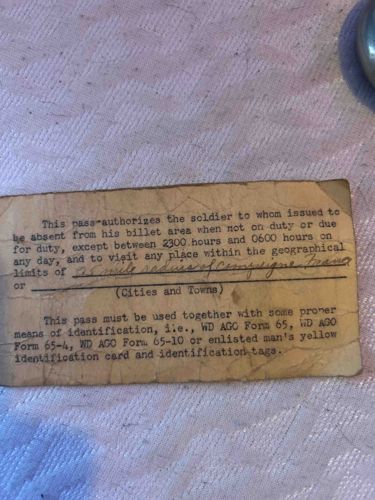
This is an original World War II-era military liberty pass, used to authorize a soldier's absence from their billet area. The rectangular document is printed on a heavy paper or light cardstock material that has developed a deep, authentic yellow-brown patina consistent with mid-20th-century age. It features black typewritten text and a handwritten ink notation specifying a '25 mile radius of Compiègne, France,' indicating its use in the European Theater of Operations. The text explicitly outlines curfews (2300 to 0600 hours) and references required identification forms such as the WD AGO Form 65. Physically, the card shows significant signs of historical utility, including heavy creasing, corner rounding, edge fraying, and minor staining, which likely resulted from being carried in a soldier's wallet or pocket. There are prominent vertical and horizontal folds, with some resulting cracking in the paper fibers. The back side is not visible, but the front serves as a poignant artifact of daily military life and administrative oversight during the 1940s wartime period. The craftsmanship is utilitarian, representative of mass-produced military stationery designed for field use.

AI-Generated Appraisal Disclaimer
Estimated Value
$35.00 - $65.00
Basic Information
Category
Military Ephemera / WWII Memorabilia
Appraised On
February 1, 2026
Estimated Value
$35.00 - $65.00
Additional Details Provided By Owner
User Provided Information
ww2
Item Description
This is an original World War II-era military liberty pass, used to authorize a soldier's absence from their billet area. The rectangular document is printed on a heavy paper or light cardstock material that has developed a deep, authentic yellow-brown patina consistent with mid-20th-century age. It features black typewritten text and a handwritten ink notation specifying a '25 mile radius of Compiègne, France,' indicating its use in the European Theater of Operations. The text explicitly outlines curfews (2300 to 0600 hours) and references required identification forms such as the WD AGO Form 65. Physically, the card shows significant signs of historical utility, including heavy creasing, corner rounding, edge fraying, and minor staining, which likely resulted from being carried in a soldier's wallet or pocket. There are prominent vertical and horizontal folds, with some resulting cracking in the paper fibers. The back side is not visible, but the front serves as a poignant artifact of daily military life and administrative oversight during the 1940s wartime period. The craftsmanship is utilitarian, representative of mass-produced military stationery designed for field use.
Get Your Items Appraised
Instant estimates of your treasures with AI-powered instant appraisals