AI estimate as of September 4, 2025 · verify with a professional before acting
AI-Generated · Verify before acting
Everything on this page is generated by AI for informational purposes only. AI can make mistakes — the AI may misidentify items or misattribute them (artist, maker, brand, designer, origin, era). This is not an official valuation and should not be used for insurance, sale, tax, estate, legal, or lending purposes — or any decision requiring a certified appraisal. It is not an authoritative claim about any person, brand, or rights holder — do not share or rely on it as a factual statement about a third party. Always consult qualified professionals before making financial decisions.
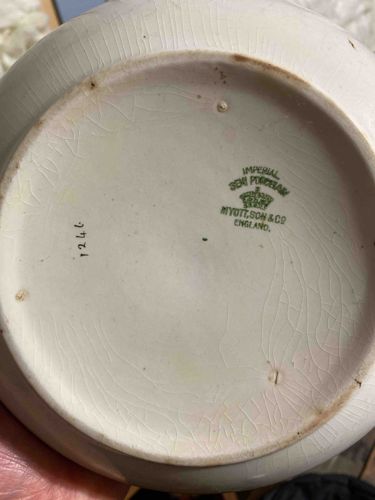
This item is the verso (bottom) of a ceramic dish or bowl, likely a serving piece, identified by its base mark. The piece is crafted from 'Imperial Semi Porcelain,' a type of earthenware with a denser, more vitreous body than typical earthenware, often used to mimic the appearance of true porcelain. The primary color visible is an off-white or cream, characteristic of underglaze transferware or ironstone. The surface exhibits extensive fine crackling throughout the glaze, a condition known as crazing, which is very common in older ceramic pieces and indicates age but not necessarily damage unless discolored.
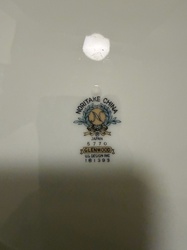
The backmark is centrally located and is a green printed stamp, featuring a crown above the text 'IMPERIAL SEMI PORCELAIN', followed by 'MYOTT, SON & CO' and 'ENGLAND'. This indicates the manufacturer as Myott, Son & Co., a Staffordshire pottery company, and confirms its English origin. The presence of 'Semi Porcelain' in the mark suggests a production period roughly between the late 19th century and mid-20th century, as this term was popular then. The crown typically signifies a higher quality or specific line within their production.
Observable condition issues include generalized crazing across the entire visible surface. There are also several small, dark pinprick marks, possibly manufacturing flaws, air bubbles that burst during firing, or minor impact marks. The edge of the footrim, where the piece rests, shows some discoloration and minor brown staining, which is consistent with age and use, possibly from residue or absorption due to the crazing. A handwritten number '1246' is present in black ink on the left side of the backmark, which could be a pattern number, inventory number, or a decorator's mark. The craftsmanship appears to be typical of mass-produced utilitarian or decorative ceramic ware of the period, with a focus on durability as suggested by 'semi porcelain', and the quality is indicated by the well-defined printed mark.
AI Appraisal Report
Having examined the image of this Myott, Son & Co. 'Imperial Semi Porcelain' ceramic bowl/dish verso, I can ascertain a reasonable appraisal. The backmark appears authentic for Myott, Son & Co., a well-known Staffordshire pottery. The 'Imperial Semi Porcelain' designation, coupled with the crown and 'ENGLAND', places its production likely between the late 19th and mid-20th centuries, a common period for such wares. The primary visible condition issue is extensive crazing, which is typical for earthenware of this age and composition. While it doesn't always denote significant damage, its widespread presence and potential for discoloration (though not clearly visible here) can detract from value. The minor pinprick marks and edge discoloration on the footrim are consistent with age, use, and manufacturing processes of the era. The handwritten '1246' is intriguing; without more context, its purpose (pattern number, inventory, etc.) is speculative but does not significantly impact value. This item is a single verso view, making a full condition assessment impossible. Without seeing the front or knowing its form (bowl, platter, etc.), or assessing for chips, cracks, or repairs on the main body, the overall condition is partially obscured. Market-wise, Myott 'Semi Porcelain' is relatively common. While it has historical interest, it is not considered rare. Demand is moderate, appealing mainly to collectors of British ceramics or those seeking vintage decorative items. Similar pieces, often full dinnerware sets, don't command extremely high prices unless they are rare patterns or in pristine condition. This piece, likely part of a larger set, would struggle to gain significant value on its own, especially with the crazing. For full authentication and condition verification, a physical inspection is crucial to assess the entire item for hidden damage, repairs, or more severe discoloration, and to confirm the exact form and pattern. Provenance documentation would also confirm its history. However, based on the image provided, its value is modest.