AI Appraisal Estimate

AI-generated estimates · not official valuations

From the user

What was submitted

Photo and notes provided by the user — not generated by AI

Submitted item photo
Submitted photo · June 20, 2026

User's notes

No additional notes provided.

AI analysis below

AI appraisal

AI analysis & estimate

AI-Generated · Verify before acting

Everything below is generated by AI for informational purposes only. AI can make mistakes — the AI may misidentify items or misattribute them (artist, maker, brand, designer, origin, era). This is not an official valuation and should not be used for insurance, sale, tax, estate, legal, or lending purposes — or any decision requiring a certified appraisal. It is not an authoritative claim about any person, brand, or rights holder — do not share or rely on it as a factual statement about a third party. Always consult qualified professionals before making financial decisions.

Read the full disclaimer

AI Identification

·Not independently authenticated·Verify before acting

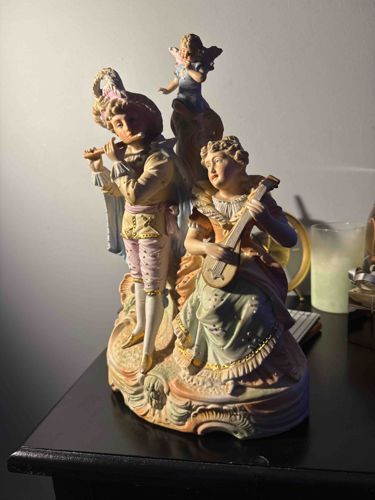
Late 19th or Early 20th Century Rococo Style Bisque Porcelain Figural Musical Group

Antique Decorative Arts - Porcelain Figurines

AI Estimated Value

·Not an official valuation·Verify before acting

$450.00 – $650.00

As of June 20, 2026

AI Item Analysis

·AI can make mistakes·Verify before acting
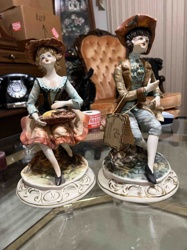
This is a multi-figure bisque porcelain group depicting a courtly musical scene in the Rococo style. The sculpture features a standing male figure playing a flute, a seated female figure playing a mandolin or lute, and a smaller cherub or winged putto perched on a rock formation behind them. The base is intricately molded with scrolling rocaille patterns and organic flourishes. The piece is crafted from matte bisque porcelain, often referred to as 'parian ware' when left unpainted, though this example features delicate polychrome hand-painting in soft pastels of pink, mint green, lavender, and yellow, accented with fine gold gilt borders. The figures are dressed in idealized late 18th-century European attire, including the male's breeches and feathered hat, and the female's ruffled gown. In terms of construction, the piece shows high-quality modeling with fine details in the facial expressions, fingers, and instruments. Notable condition issues include a missing segment of the flute held by the male figure (likely broken off) and typical surface dust and minor grime accumulation in the crevices, which is common for matte porcelain finishes. There is slight wear to the gilt highlights along the base and garment edges. The style suggests a late 19th to early 20th-century manufacture, likely from a European maker such as Dresden, Meissen, or Capodimonte (or a high-quality imitation thereof). No maker's mark is visible in the photograph, but such marks are typically located on the underside of the base. The overall craftsmanship is refined, indicating a decorative piece intended for a middle-to-upper-class interior during the Victorian or Edwardian eras.
AI Appraisal Report

·AI can make mistakes·Verify before acting
I have virtually examined this hand-painted bisque porcelain figural group. This piece is a classic example of late 19th-century Rococo Revival decorative arts, likely of German origin (possibly Sitzendorf or a Dresden-area factory). The modeling shows fine localized detail, particularly in the floral applications and the physiognomy of the figures, though the matte parian-style finish is indicative of late Victorian mass-production for the middle-market. The market for 19th-century figurines has softened significantly over the last decade, as current interior design trends favor minimalism. However, large, multi-figure musical groups retain a steady baseline of interest among traditional collectors. The primary detractor here is the condition; the loss of the flute end and wear to the gilding significantly impacts the value, as porcelain collectors prioritize pristine condition. Authenticity appears consistent with the period, but a definitive attribution is impossible without a physical inspection of the underside for maker’s marks—such as the blue crossed swords (Meissen) or crowned 'N' (Capodimonte). From the images, I note no signs of modern resin reproduction, appearing instead to be true kiln-fired porcelain. Limitation Disclosure: This appraisal is based solely on visual photographic evidence. A formal valuation would require a physical inspection to check for hidden structural repairs (often visible under UV light), professional cleaning to assess surface integrity, and documented provenance. The absence of a visible mark suggests it may be a 'quality export' piece rather than a premier house brand, which caps the valuation within the provided range.

Get your items appraised

Instant estimates of your treasures with AI-powered appraisals

Browse More Appraisals