Paleolithic Period Lithic Hand Axe or Celt
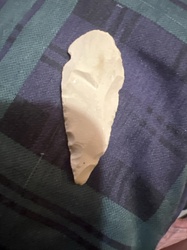
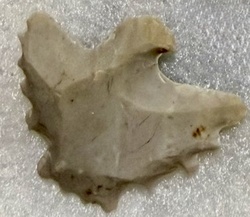
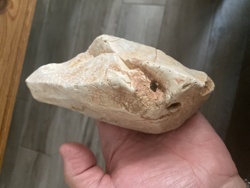
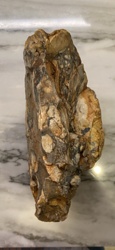
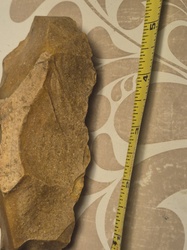
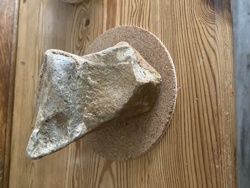
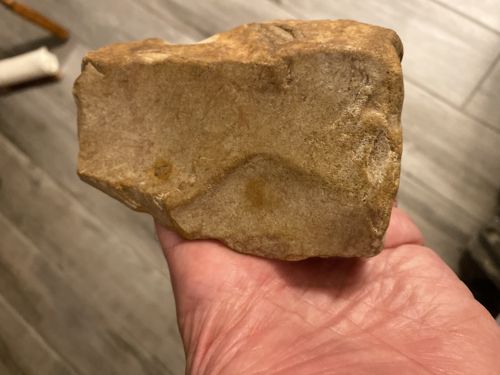
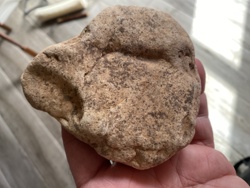
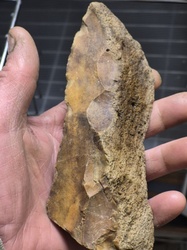
This is a prehistoric lithic tool, commonly referred to as a hand axe, spade, or celt, recovered from Guthrie, Oklahoma. Measuring approximately 4 inches by 3 inches, the item is crafted from a dense, fine-grained stone, likely chert or a high-silica sandstone, exhibiting a distinct yellowish-brown or ochre patina consistent with long-term burial in mineral-rich soil. The construction shows evidence of bifacial percussion flaking, where large flakes were removed to achieve its tapered, wedge-like shape. One end appears broad and blunt, suitable for a hand grip, while the opposing end tapers toward a utilized edge. The surface displays significant weathering and 'desert varnish'—a smooth, shiny coating formed by oxidation over millennia—which softens the original flake scars. There are no modern maker's marks or signatures, which is typical for artifacts of the Paleolithic era. Notable condition issues include minor edge battering and rounded corners, likely a combination of original use-wear and natural alluvial erosion over thousands of years. The weight appears substantial for its size, providing the necessary heft for chopping or scraping tasks. Its discovery in the Central United States suggests it could belong to an early indigenous cultural horizon, potentially predating or coinciding with Clovis manufacturing techniques. The craftsmanship is utilitarian yet deliberate, showing a high level of prehistoric engineering in material selection and form.
AI-Generated Appraisal Disclaimer
Estimated Value
$100 - $250
Basic Information
Category
Prehistoric Artifacts / Antiquities
Appraised On
February 18, 2026
Estimated Value
$100 - $250
Additional Details Provided By Owner
User Provided Information
Stone age lithic hand axe spade or celt from the Paleolithic period. Found in Guthrie Ok measuring 4" x 3"
Item Description
This is a prehistoric lithic tool, commonly referred to as a hand axe, spade, or celt, recovered from Guthrie, Oklahoma. Measuring approximately 4 inches by 3 inches, the item is crafted from a dense, fine-grained stone, likely chert or a high-silica sandstone, exhibiting a distinct yellowish-brown or ochre patina consistent with long-term burial in mineral-rich soil. The construction shows evidence of bifacial percussion flaking, where large flakes were removed to achieve its tapered, wedge-like shape. One end appears broad and blunt, suitable for a hand grip, while the opposing end tapers toward a utilized edge. The surface displays significant weathering and 'desert varnish'—a smooth, shiny coating formed by oxidation over millennia—which softens the original flake scars. There are no modern maker's marks or signatures, which is typical for artifacts of the Paleolithic era. Notable condition issues include minor edge battering and rounded corners, likely a combination of original use-wear and natural alluvial erosion over thousands of years. The weight appears substantial for its size, providing the necessary heft for chopping or scraping tasks. Its discovery in the Central United States suggests it could belong to an early indigenous cultural horizon, potentially predating or coinciding with Clovis manufacturing techniques. The craftsmanship is utilitarian yet deliberate, showing a high level of prehistoric engineering in material selection and form.
Get Your Items Appraised
Instant estimates of your treasures with AI-powered instant appraisals