These notes were written by the person who submitted this item. Appraiser.AI has not verified them, and the AI's identification and estimate may rely on them.
AI Estimated Value
Not an official valuation
$75 - $125
AI estimate as of September 6, 2025 · verify with a professional before acting
AI-Generated · Verify before acting
Everything on this page is generated by AI for informational purposes only. AI can make mistakes — the AI may misidentify items or misattribute them (artist, maker, brand, designer, origin, era). This is not an official valuation and should not be used for insurance, sale, tax, estate, legal, or lending purposes — or any decision requiring a certified appraisal. It is not an authoritative claim about any person, brand, or rights holder — do not share or rely on it as a factual statement about a third party. Always consult qualified professionals before making financial decisions.
This analysis also relies on unverified notes provided by the user, which may be incomplete or inaccurate and could affect the result.
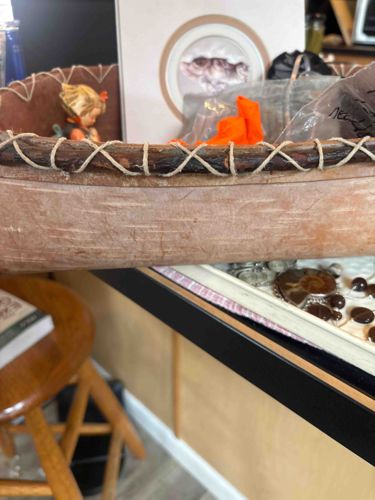
This item is a miniature decorative canoe, likely crafted from birch bark and small wooden branches, consistent with traditional Alaskan or Native American artistry. The primary material appears to be a light-colored, natural birch bark, showing characteristic layered textures and some natural striations. The color palette is predominantly earthy tones, exhibiting shades of light brown, beige, and natural wood. The top edge, or gunwale, of the canoe is formed by a natural, slender branch, possibly willow or a similar flexible wood, which retains its bark, giving it a rustic appearance. This branch is expertly lashed to the birch bark hull with what appears to be a light-colored, possibly sinew or natural fiber, string or cord, arranged in a distinctive crisscross pattern. This lashing provides both structural integrity and a strong aesthetic element. While the exact dimensions are not provided, it appears to be a smaller, perhaps tabletop-sized, decorative item rather than a functional watercraft. There are no visible significant condition issues such as cracks, major tears, or repairs, though the natural materials might exhibit subtle signs of age or minor wear consistent with display. The craftsmanship suggests a handmade item, showcasing traditional techniques and attention to detail in the lashing and shaping of the bark. It lacks discernible maker's marks or signatures from the visible portion, which is common for handcrafted indigenous art. Given the context of 'Alaskan art', it is likely a modern or mid-20th century decorative piece, perhaps made for the tourist trade or as a display of traditional craft.
AI Appraisal Report
Upon my virtual examination of the Miniature Birch Bark Canoe, I find it to be a well-crafted decorative item consistent with traditional Alaskan or Native American artistry, likely intended as a display piece. The condition appears to be excellent from the provided image; I observe no significant damage such as cracks, major tears, or repairs. The natural materials, birch bark and a slender branch gunwale secured with lashing, seem well-preserved, exhibiting only expected subtle signs of age for a natural fiber item.
Authenticator's Notes: Based purely on the visual information, I assess this piece as authentic to its described type – a handmade miniature canoe. However, without a physical inspection, specific material identification (e.g., verifying 'sinew'), definitive confirmation of age, or to fully rule out modern replicas, true authenticity to a specific indigenous maker or period cannot be absolutely confirmed. A hands-on examination would allow for tactile assessment of materials, closer inspection for any hidden maker's marks, and analysis of construction techniques that might narrow down origin. Provenance documentation, if available, would be invaluable.
Demand for such decorative indigenous craft items is generally steady, but not exceptionally high. While there's appreciation for traditional techniques, the market for miniature birch bark canoes, particularly without specific tribal attribution or historical significance, tends to be modest. Comparables often appear in online marketplaces and smaller antique shops, typically ranging from $50 to $150 depending on craftsmanship, size, and perceived age. The absence of a discernible maker’s mark or strong provenance limits its potential as a significant collectible. Factors impacting value positively include its good condition and the evident traditional craftsmanship in the lashing and shaping. Its likely origin as Alaskan art, possibly for the tourist trade, positions it as a desirable souvenir or decorative accent rather than a high-value tribal artifact.