Set of Indian Silver cocktail glasses. Reportedly from the Estate of Helen Hayes. Was dropped off as a dog to a Helen Hayes Hospital rummage sale by her late son James MacArthur
These notes were written by the person who submitted this item. Appraiser.AI has not verified them, and the AI's identification and estimate may rely on them.
AI Estimated Value
Not an official valuation
$150-250
AI estimate as of August 4, 2025 · verify with a professional before acting
AI-Generated · Verify before acting
Everything on this page is generated by AI for informational purposes only. AI can make mistakes — the AI may misidentify items or misattribute them (artist, maker, brand, designer, origin, era). This is not an official valuation and should not be used for insurance, sale, tax, estate, legal, or lending purposes — or any decision requiring a certified appraisal. It is not an authoritative claim about any person, brand, or rights holder — do not share or rely on it as a factual statement about a third party. Always consult qualified professionals before making financial decisions.
This analysis also relies on unverified notes provided by the user, which may be incomplete or inaccurate and could affect the result.
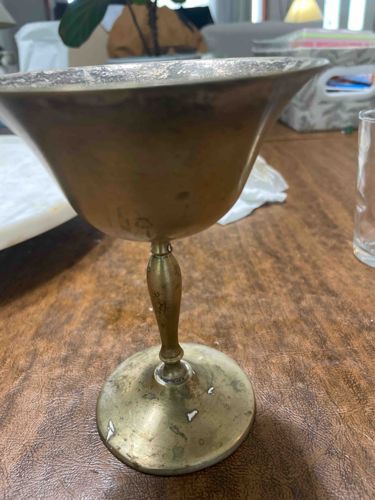
This item is a single, handled goblet or cocktail glass, reportedly part of a set of Indian silver cocktail glasses. However, based on the visual evidence, the primary material appears to be brass or a brass alloy, not silver, with some areas indicating a silver plate that has worn off. The cup portion is wide and shallow, characteristic of a cocktail glass or chalice. The interior of the cup shows significant tarnishing and discoloration, suggesting it has been used or exposed to elements for a considerable period. The exterior of the cup is also heavily tarnished, displaying a dull, aged brass patina, especially towards the bottom where it connects to the stem. The rim of the cup, while also tarnished, shows patches of what might have been original silver plating or a lighter metal finish. The stem is distinctively shaped, having a tapering, elongated bulbous form that widens towards the cup and the base, suggesting a turned or cast design. It exhibits similar wear and brassy patina as the cup. The base is circular and flat, providing stability. It matches the material and patina of the rest of the object, showing several distinct areas where the darker brass is exposed through a lighter, perhaps silvered, surface layer, particularly visible as irregular, lighter-colored spots on the dark base. These spots are indicative of wear, rubbing, or chemical interaction that has removed an outer coating. The overall condition suggests significant age and usage, with heavy tarnish and patination consistent with an item from the mid-20th century or earlier, aligning with the reported provenance from the Helen Hayes estate. The craftsmanship appears sturdy but not overtly ornate, typical of functional yet decorative drinkware. The visible wear points, particularly on the base and rim, hint at a plating that has deteriorated over time, rather than solid silver composition. No clear maker's marks or signatures are discernible from the provided images, which makes precise manufacturing attribution difficult without further inspection.
AI Appraisal Report
Upon examining the provided image of this single handled goblet, significant conclusions can be drawn regarding its condition and potential value, though with limitations inherent to remote appraisal. The object, described as an Indian Brass and Silver-Plated Cocktail Glass, clearly shows primary material as brass or a brass alloy, not solid silver. The visible erosion and discoloration of what appears to be silver plating, particularly on the rim and base, confirms this observation. The heavy tarnish and patination across the entire piece are consistent with significant age and usage, likely aligning with the mid-20th century as suggested. This wear, while diminishing the aesthetic appeal in some respects, also attests to its authenticity as an aged item. The craftsmanship appears functional rather than highly ornate, typical of utility drinkware of the period.
The most significant factor impacting its value is the reported provenance from the Helen Hayes estate, specifically its purported drop-off by James MacArthur at a hospital rummage sale. This celebrity provenance, if fully authenticated, would dramatically elevate its market desirability. Without physical examination, however, I cannot definitively verify the authenticity of the item as originating from Helen Hayes' personal collection. In-person inspection would allow for closer examination of any non-visible maker's marks, definitive material identification through testing, and assessment of micro-wear patterns. Crucially, full authentication would require documented proof of provenance, such as a bill of sale, estate records, or a letter of authenticity directly from the estate or James MacArthur himself. Without such documentation, the provenance remains anecdotal, limiting its impact on value. Market conditions for decorative brassware are generally modest, but celebrity provenance can create a niche demand among collectors of entertainment memorabilia. Comparables for similar non-provenance Indian brass/plated goblets would be low, likely in the $20-$50 range per piece. However, if the provenance were unequivocally proven, the value could soar. Given the current information, balancing the visible condition with the unverified but compelling provenance, I lean towards a valuation that acknowledges the potential, yet remains conservative due to the lack of hard evidence for the celebrity connection.