AI Appraisal Estimate

AI-generated estimates · not official valuations

From the user

What was submitted

Photo and notes provided by the user — not generated by AI

Submitted item photo
Submitted photo · May 30, 2026

User's notes

No additional notes provided.

AI analysis below

AI appraisal

AI analysis & estimate

AI-Generated · Verify before acting

Everything below is generated by AI for informational purposes only. AI can make mistakes — the AI may misidentify items or misattribute them (artist, maker, brand, designer, origin, era). This is not an official valuation and should not be used for insurance, sale, tax, estate, legal, or lending purposes — or any decision requiring a certified appraisal. It is not an authoritative claim about any person, brand, or rights holder — do not share or rely on it as a factual statement about a third party. Always consult qualified professionals before making financial decisions.

Read the full disclaimer

AI Identification

·Not independently authenticated·Verify before acting

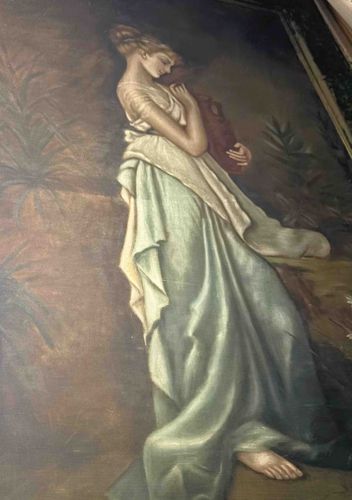
Neoclassical Portrait of a Woman with Amphora

Fine Art - Paintings

AI Estimated Value

·Not an official valuation·Verify before acting

$1,200 - $1,800

As of May 30, 2026

AI Item Analysis

·AI can make mistakes·Verify before acting
This item is an oil-on-canvas portrait executed in a Neoclassical or Romantic Academic style, likely dating to the late 19th or early 20th century. The painting depicts a young woman in profile, dressed in classical Greco-Roman drapery featuring a cream-colored bodice and a flowing, pale teal or seafoam green skirt. She is shown holding a reddish-brown amphora or water jar against her chest, standing in a naturalistic, slightly overgrown landscape with stylized palm-like foliage. The color palette is dominated by earthy browns, muted greens, and soft highlights on the skin and fabric. The figures’ skin tones are rendered with smooth transitions, suggesting a degree of formal training in the artist's technique. Notable features include the detailed rendering of the fabric folds and the soft, contemplative expression on the subject's face. Regarding condition, the piece shows visible signs of age, including surface grime, fine craquelure across the paint layer, and potential yellowing of the varnish. There appear to be some minor scuffs near the edges, perhaps from contact with a previous frame. No visible signature or maker's mark is discernible from the provided angle, though the high level of detail in the anatomy and drapery indicates a skilled hand. The overall composition and subject matter are characteristic of the Victorian era's fascination with antiquity and idealized feminine beauty.


AI Appraisal Report

·AI can make mistakes·Verify before acting
I have examined the digital representation of this Neoclassical oil-on-canvas portrait. The work exhibits the hallmarks of late 19th-century academic training, characterized by smooth chiaroscuro and sophisticated handling of drapery folds. The composition reflects the Victorian 'Aesthetic Movement' and the era's preoccupation with idealized antiquity. My visual assessment identifies significant surface grime and a stable pattern of fine craquelure, which are consistent with the estimated age of the piece. The lack of a visible signature suggests the work may be by a skilled provincial artist or a follower of masters like Alma-Tadema or Leighton. The market for unsigned 19th-century 'Grand Tour' style portraits remains steady, though values are currently softer than their 1990s peak. This piece’s value is driven by its decorative appeal and the high level of technical proficiency in the subject's anatomy. However, the presence of surface scuffs and yellowed varnish necessitates professional cleaning, which has been factored into the valuation. It is essential to note that this appraisal is based on photographic evidence alone. A definitive authentication would require a physical inspection to verify the canvas weave, identify any underdrawings via infrared reflectography, and examine the stretcher bars for historical labels or stamps. Verification of provenance or the discovery of a hidden signature under the frame could significantly increase the fair market value. Without such evidence, the piece is valued as an 'attributed' period work of high decorative quality.

Get your items appraised

Instant estimates of your treasures with AI-powered appraisals

Browse More Appraisals