AI estimate as of October 9, 2025 · verify with a professional before acting
AI-Generated · Verify before acting
Everything on this page is generated by AI for informational purposes only. AI can make mistakes — the AI may misidentify items or misattribute them (artist, maker, brand, designer, origin, era). This is not an official valuation and should not be used for insurance, sale, tax, estate, legal, or lending purposes — or any decision requiring a certified appraisal. It is not an authoritative claim about any person, brand, or rights holder — do not share or rely on it as a factual statement about a third party. Always consult qualified professionals before making financial decisions.
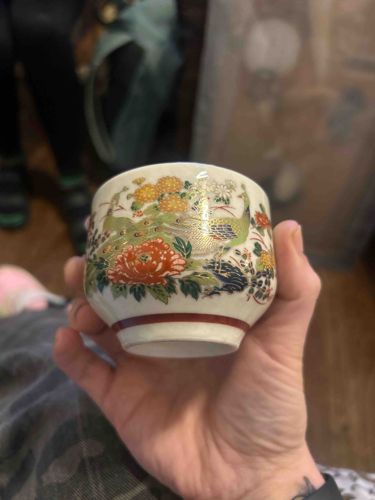
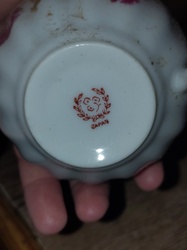
This item is a Japanese porcelain cup, likely a yunomi (a type of teacup without a handle), featuring an intricate Imari-style decoration. The cup has a typical form for a yunomi, with a slightly flaring rim and a gently tapering body to a smaller, footed base. The primary color of the porcelain body is a creamy white, serving as a bright canvas for the vibrant polychrome and gilt decoration. The design prominently features a peacock motif rendered in shades of green, blue, and black, with highly detailed golden accents on its feathers, wings, and head, indicating a rich use of gilding. Lush floral elements, including large red peonies, smaller yellow chrysanthemums, and other delicate white and multicolored blossoms, are interspersed around the peacock and across the cup's surface, creating a dense and opulent pattern typical of Kutani or Satsuma styles, though often generally referred to as Imari-style for its rich palette. Dark green foliage and possibly blue rocks or water features fill the background, adding depth to the scene. Near the base, there is a distinct reddish-brown band, providing a clear border to the decorative area. The construction appears to be fine quality porcelain, given the smooth, luminous surface visible where the glaze is not covered by decoration. The condition appears to be excellent with no visible chips, cracks, or significant wear to the vibrant decoration or gilding, suggesting careful handling or display. The craftsmanship is evident in the detailed brushwork and the skillful application of multiple colors and gold, creating a sophisticated and luxurious aesthetic. The item's style period is likely mid-20th century, given the vibrancy of the colors and the particular representation of the motifs, without signs of extreme age. There are no visible maker's marks or signatures in the provided images, but these are often found on the underside of the base. The proportions suggest it is a standard size teacup, suitable for holding in one hand.
AI Appraisal Report
Based on my visual examination of the provided image, this Japanese Imari-style porcelain teacup, or yunomi, presents in excellent condition. The colors are remarkably vibrant, the gilding is intact with no apparent loss, and the porcelain body shows no visible chips, cracks, or repairs. This strong condition significantly enhances its market appeal. The intricate decoration featuring a peacock, peonies, and chrysanthemums, rendered with fine brushwork and a rich palette, is characteristic of the quality often associated with Japanese export porcelain from the mid-20th century. While the style is broadly referred to as 'Imari,' the dense floral and figural motifs with extensive gilding also share characteristics with Kutani or Satsuma ware, indicating a desirable aesthetic. The absence of visible maker's marks is common for this type of ware, and without a physical inspection or clearer image of the base, I cannot confirm any specific workshop. Currently, the market for Japanese decorative porcelain, particularly mid-20th century pieces, is stable but not experiencing a surge in demand for non-antique items without prominent artist signatures or historical provenance. Comparables for similar high-quality, decorative yunomi of this era typically fall within a modest range. The item's primary value is decorative, appealing to collectors of Japanese ceramics and those seeking ornate accent pieces. For full authentication and to ascertain a more precise age, a hands-on examination to check for firing imperfections, precise porcelain body characteristics, and potential invisible repairs, along with searching for obscured base marks, would be crucial. Provenance documentation, if available, would also significantly aid in establishing its history and potential rarity. However, based on the image, this is a well-preserved and attractive piece of its type.