AI estimate as of December 13, 2025 · verify with a professional before acting
AI-Generated · Verify before acting
Everything on this page is generated by AI for informational purposes only. AI can make mistakes — the AI may misidentify items or misattribute them (artist, maker, brand, designer, origin, era). This is not an official valuation and should not be used for insurance, sale, tax, estate, legal, or lending purposes — or any decision requiring a certified appraisal. It is not an authoritative claim about any person, brand, or rights holder — do not share or rely on it as a factual statement about a third party. Always consult qualified professionals before making financial decisions.
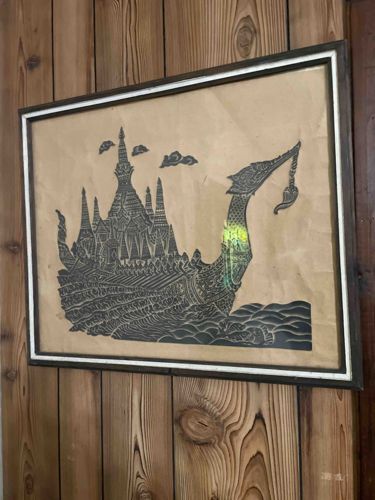
This is a framed silkscreen print depicting a traditional Thai Naga barge or royal ceremonial boat. The print is rendered in black ink on what appears to be a light brown, possibly kraft paper or natural fiber paper, highlighting the intricate details of the vessel. The barge itself features a multi-tiered, elaborate structure resembling a temple or stupa at its stern, indicative of grand architectural elements found in Southeast Asian design. The bow is distinctively shaped like the head of a mythical Naga serpent or a Hamsa bird, characteristic of significant royal barges used in Thailand and neighboring regions. The 'waves' beneath the boat are stylized and bold. There are also faint, indistinct cloud-like motifs in the upper left background. A notable feature is a splash of iridescent green/yellow color on the bow, possibly a deliberate artistic enhancement or a form of reflective material applied to selectively highlight that area. The print is housed under glass in a simple, rectangular frame with a dark brown or black outer border and a narrower white or off-white inner border, creating a matted effect. The paper itself shows signs of age, including some creasing, particularly visible in the upper right quadrant, and a general antique patina. It appears to be an older piece, likely from the mid to late 20th century, given the style and materials. The craftsmanship of the print is detailed, showing fine lines and patterns within the main structures of the barge, suggesting a skilled hand in the silkscreen process. The overall condition suggests minor wear consistent with its age.
AI Appraisal Report
I have virtually examined this framed silkscreen print depicting a Thai Naga barge. Based on the provided image, the print appears to be an authentic silkscreen, characterized by its crisp lines and the texture often inherent in this printmaking method. The paper, possibly kraft or natural fiber, exhibits an aged patina and minor creasing, especially in the upper right quadrant, consistent with its estimated age from the mid to late 20th century. The splash of iridescent green/yellow on the bow is a curious feature; without physical inspection, I cannot ascertain if it's an intentional artistic embellishment, a type of reflective material, or a later alteration. This distinct coloration potentially adds a unique aspect to the piece but would require in-person examination to confirm its origin and intent.
From a market perspective, traditional Thai-themed silkscreen prints, while culturally rich, generally occupy a niche market. The demand for such pieces is moderate, primarily appealing to collectors of Southeast Asian art or those seeking decorative items with cultural significance. Rarity is difficult to assess without knowledge of the edition size or artist, neither of which is discernible from the image. Comparable sales for unsigned or unidentified silkscreen prints of similar subject matter and age typically fall within the $100-$300 range, depending on condition and artistic execution. The simple framing is adequate but not of high value, and the condition, while showing age, does not present major damage that would significantly devalue it.
Factors impacting value include the lack of artist signature or edition information, which limits its appeal to serious fine art collectors. The iridescent splash, depending on its authenticity and artistic intent, could either slightly enhance or detract from its value if deemed an alteration. For full authentication, I would require an in-person examination to verify the media components—specifically the nature of the iridescent pigment—and to assess the paper's true age and composition. Provenance documentation, such as where and when it was acquired, would greatly assist in solidifying its authenticity and market history.