AI Appraisal Estimate

AI-generated estimates · not official valuations

From the user

What was submitted

Photo and notes provided by the user — not generated by AI

Submitted item photo
Submitted photo · May 25, 2026

User's notes

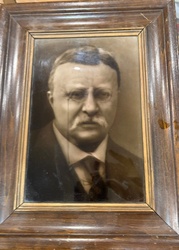
Portrait 1800s

AI analysis below

AI appraisal

AI analysis & estimate

AI-Generated · Verify before acting

Everything below is generated by AI for informational purposes only. AI can make mistakes — the AI may misidentify items or misattribute them (artist, maker, brand, designer, origin, era). This is not an official valuation and should not be used for insurance, sale, tax, estate, legal, or lending purposes — or any decision requiring a certified appraisal. It is not an authoritative claim about any person, brand, or rights holder — do not share or rely on it as a factual statement about a third party. Always consult qualified professionals before making financial decisions.

Note

This analysis also relies on unverified notes provided by the user, which may be incomplete or inaccurate and could affect the result.

Read the full disclaimer

AI Identification

·Not independently authenticated·Verify before acting

Late 19th-Century Oval Crayon Portrait

Antique Art & Photography

AI Estimated Value

·Not an official valuation·Verify before acting

$75-125

As of May 25, 2026

AI Item Analysis

·AI can make mistakes·Verify before acting
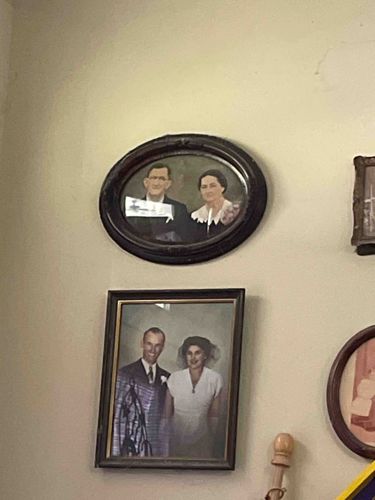
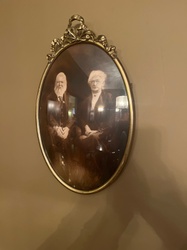
This item is an antique oval-framed crayon portrait (also known as a solar print or charcoal enlargement) dating from the late 19th century, likely between 1880 and 1900. The portrait depicts a middle-aged man and woman in Victorian-era attire. The man wears dark formal clothing with spectacles, while the woman is dressed in a dark bodice featuring a prominent white lace collar. The image is presented in a deep-profile, oval-shaped wooden frame with a dark mahogany or walnut finish, which was highly popular during the late Victorian period. The portrait displays significant physical distress; there is a major linear tear or large area of paper loss running horizontally across the man's chest and lapel, revealing a white substrate beneath. The surface shows atmospheric foxing and generalized fading consistent with age and exposure to light. The craftsmanship reflects the era's common technique of using a faint photographic base that was meticulously hand-finished with charcoal and pastels to give it a painterly, three-dimensional look. The textured background and subtle flesh tones are characteristic of this composite photographic-artistic medium. The glass appears to be original, though it shows some surface grime.
AI Appraisal Report

·AI can make mistakes·Verify before acting
I have examined the digital representation of this Late 19th-Century Oval Crayon Portrait. The piece is a classic 'solar enlargement,' a composite medium where a faint photographic base was enhanced with charcoal, crayon, or pastels. Stylistically, the attire and oval convex format date the work to approximately 1885–1895. While the mahogany-finished Victorian frame appears authentic to the period and retains its original aesthetic gravity, the portrait itself suffers from severe condition issues. The prominent horizontal tear across the male subject's chest significantly compromises the visual integrity and marketability of the piece. Furthermore, the visible foxing and atmospheric fading suggest a history of improper environmental storage. In the current market, these portraits are primarily sought after for their decorative ‘antique’ appeal rather than as fine art, unless the subjects are historically significant. Comparable sales for similar portraits in good condition typically range from $200–$300; however, the substantial damage here necessitates a significant reduction in valuation to reflect the high cost of professional paper restoration. This appraisal is based on photographic evidence and carries inherent limitations. A physical examination is required to determine if the backing board is acidic and causing ongoing degradation. Furthermore, a signature or studio stamp, often hidden behind the frame lip or on the reverse, would be necessary to identify the artist or photographer. Without a documented provenance linking the subjects to a specific family or historical event, the value remains tied strictly to its decorative merit as a period artifact.

Get your items appraised

Instant estimates of your treasures with AI-powered appraisals

Browse More Appraisals