AI Appraisal Estimate

AI-generated estimates · not official valuations

From the user

What was submitted

Photo and notes provided by the user — not generated by AI

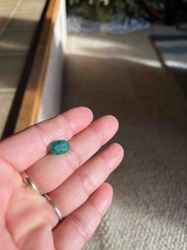
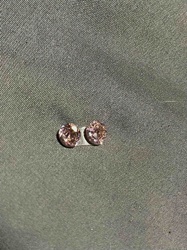
Submitted item photo
Submitted photo · June 25, 2026

User's notes

No additional notes provided.

AI analysis below

AI appraisal

AI analysis & estimate

AI-Generated · Verify before acting

Everything below is generated by AI for informational purposes only. AI can make mistakes — the AI may misidentify items or misattribute them (artist, maker, brand, designer, origin, era). This is not an official valuation and should not be used for insurance, sale, tax, estate, legal, or lending purposes — or any decision requiring a certified appraisal. It is not an authoritative claim about any person, brand, or rights holder — do not share or rely on it as a factual statement about a third party. Always consult qualified professionals before making financial decisions.

Read the full disclaimer

AI Identification

·Not independently authenticated·Verify before acting

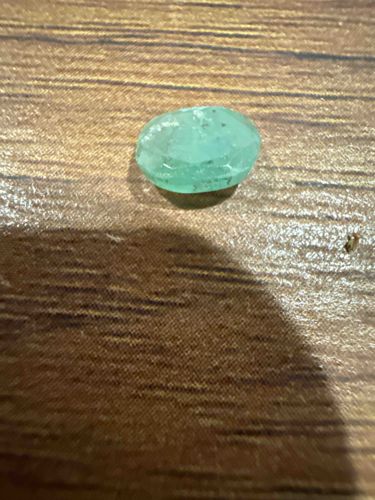
Oval-Cut Green Gemstone (Suspected Emerald)

Loose Gemstones / Jewelry Components

AI Estimated Value

·Not an official valuation·Verify before acting

$450 - $650

As of June 25, 2026

AI Item Analysis

·AI can make mistakes·Verify before acting
This item is a loose, oval-cut gemstone featuring a medium-light, slightly bluish-green hue, characteristic of an emerald. The stone exhibits significant internal inclusions, commonly referred to as 'jardin' in emeralds, which appear as fractures, feathers, and cloud-like structures throughout the table and pavilion. These inclusions drastically impact the clarity of the stone, giving it a translucent to semi-opaque appearance rather than being transparent. The cut is an oval mixed cut with visible facet edges that appear somewhat softened, potentially indicating wear or a lower-precision lapidary execution. Regarding condition, there is a prominent surface-reaching inclusion or chip visible near the center of the table, and minor abrasions are noticeable along the girdle. The color saturation is moderate, and while the stone possesses the classic green of the beryl family, it lacks the high-intensity vividness found in premium specimens. There are no visible maker's marks or laser inscriptions, which is typical for untreated or commercially graded loose stones. The craftsmanship shows standard commercial faceting rather than a master artisan cut, as evidenced by slight asymmetries in the facet junctions. Without laboratory testing, the origin and treatment status (such as oiling or resin filling) remain unknown, though its heavily included nature is consistent with natural formation.
AI Appraisal Report

·AI can make mistakes·Verify before acting
I have conducted a visual examination of this oval-cut green gemstone, suspected to be a natural emerald. The stone exhibits a medium-light, slightly bluish-green hue with moderate saturation. The most striking feature is the extensive 'jardin'—a network of internal inclusions including feathers and fractures. These inclusions significantly impede light return, resulting in a translucent to semi-opaque clarity. I noted a prominent surface-reaching fissure on the table and minor abrasions along the girdle, suggesting a softer crystalline structure or standard wear. From a market perspective, this specimen falls into the commercial grade category. High-value emeralds are prized for transparency and vivid saturation; this stone’s heavy inclusions and asymmetric faceting limit its appeal to custom artisan jewelry or collectors looking for a natural look over brilliance. Comparables for loose emeralds of this size and clarity typically trade in the mid-hundreds. The lack of 'vivid' saturation and the presence of significant surface-reaching internal structures keep it from the premium price brackets. Several critical limitations exist with this remote assessment. I cannot definitively confirm the species as natural Emerald (Beryl) without testing its Refractive Index and Specific Gravity; it could potentially be a synthetic counterpart or a different green mineral. Furthermore, the value is highly dependent on the level of clarity enhancement (oiling or resin filling). A physical examination by a GIA-certified gemologist using a microscope and spectroscopy would be required to determine the origin and the extent of any treatments, which could swing the value by 30-50%.

Get your items appraised

Instant estimates of your treasures with AI-powered appraisals

Browse More Appraisals