AI Appraisal Estimate

AI-generated estimates · not official valuations

From the user

What was submitted

Photo and notes provided by the user — not generated by AI

Submitted item photo
Submitted photo · June 18, 2026

User's notes

No additional notes provided.

AI analysis below

AI appraisal

AI analysis & estimate

AI-Generated · Verify before acting

Everything below is generated by AI for informational purposes only. AI can make mistakes — the AI may misidentify items or misattribute them (artist, maker, brand, designer, origin, era). This is not an official valuation and should not be used for insurance, sale, tax, estate, legal, or lending purposes — or any decision requiring a certified appraisal. It is not an authoritative claim about any person, brand, or rights holder — do not share or rely on it as a factual statement about a third party. Always consult qualified professionals before making financial decisions.

Read the full disclaimer

AI Identification

·Not independently authenticated·Verify before acting

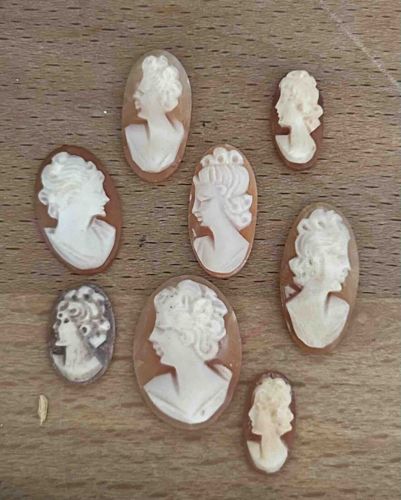
Collection of Eight Unset Shell Cameos

Jewelry Components / Antiques & Collectibles

AI Estimated Value

·Not an official valuation·Verify before acting

$250.00 - $400.00

As of June 18, 2026

AI Item Analysis

·AI can make mistakes·Verify before acting
This is a collection of eight loose, unset cameo cabochons, likely carved from helmet or conch shells. The collection features various sizes of oval-shaped cameos, each depicting a classical female profile in relief. The color palette across the pieces transition from a creamy white for the raised carvings to a warm peachy-tan or brownish background, characteristic of natural shell layering. The carvings vary in detail and complexity; some exhibit more refined hairstyles and facial features than others. The smallest piece on the left appears to have a darker, more greyish background, suggesting a different shell type like sardonyx shell. In terms of condition, the pieces show evidence of being out of their original settings, with some minor chipping visible along the outer edges of the shell bases. The relief carvings generally appear crisp, though some darkening or accumulation of dust is present in the deeper crevices of the hair. There are no visible maker's marks, as these were typically artisan-carved pieces intended for jewelry manufacturers. Based on the style of the hair and the profile silhouettes, these likely date from the mid-to-late 20th century, following traditional Victorian motifs. The craftsmanship varies from mass-produced commercial quality to more hand-finished artisan work, noted by the slight anatomical differences in each lady's profile.
AI Appraisal Report

·AI can make mistakes·Verify before acting
I have examined the collection of eight unset shell cameos via high-resolution imagery. These pieces are identified as traditional shell carvings, likely utilizing Bull’s Mouth (Cassis rufa) or Black Helmet (Cassis madagascariensis) shells to achieve the color contrast between the white relief and peachy/brown strata. Based on the profile silhouettes and 'button' style hair arrangements, I date these to the mid-20th century. The craftsmanship appears to be mid-tier commercial quality; while the carvings are crisp, they lack the high-relief complexity found in 19th-century masterworks or the signature styles of renowned Torre del Greco artisans. I observed minor edge chipping and 'nicking' on the bezel boundaries, common in stones removed from metal mountings. The smallest piece exhibits a darker ground, likely sardonyx shell, which generally commands a slight premium due to hardness and higher contrast. Market demand for loose, modern-era cameos has remained steady but modest, primarily driven by boutique jewelry designers and hobbyist collectors. Without silver or gold settings, the value rests solely on the carving quality and size. From these images, I cannot perform a transillumination test to detect internal stress cracks or 'crazing' common in aged organic materials. A physical inspection would be required to confirm the absence of synthetic substitutes like molded plastic or 'calcite' composites, though the natural layering visible here suggests authenticity. Full authentication would require microscopic examination of the carve marks to distinguish between hand-graver work and modern ultrasonic milling, as well as a standardized 'hot point' test to confirm the calcium carbonate structure of the shell.

Get your items appraised

Instant estimates of your treasures with AI-powered appraisals

Browse More Appraisals