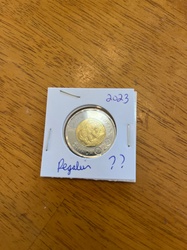
These notes were written by the person who submitted this item. Appraiser.AI has not verified them, and the AI's identification and estimate may rely on them.
AI Estimated Value
Not an official valuation
$15-30
AI estimate as of July 13, 2025 · verify with a professional before acting
AI-Generated · Verify before acting
Everything on this page is generated by AI for informational purposes only. AI can make mistakes — the AI may misidentify items or misattribute them (artist, maker, brand, designer, origin, era). This is not an official valuation and should not be used for insurance, sale, tax, estate, legal, or lending purposes — or any decision requiring a certified appraisal. It is not an authoritative claim about any person, brand, or rights holder — do not share or rely on it as a factual statement about a third party. Always consult qualified professionals before making financial decisions.
This analysis also relies on unverified notes provided by the user, which may be incomplete or inaccurate and could affect the result.
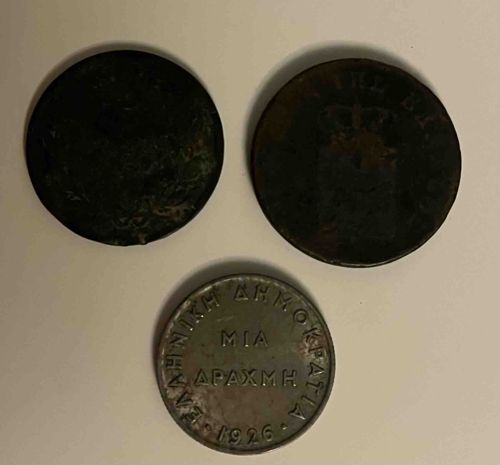
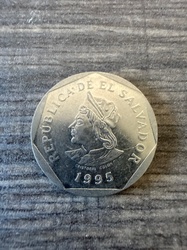
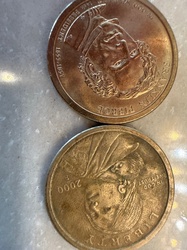
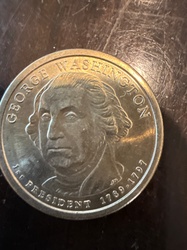
This lot consists of three circular metal objects, likely coins or tokens. One clearly identifiable item is a Greek 1 Drachma coin from 1926. This coin features the inscription "ΕΛΛΗΝΙΚΗ ΔΗΜΟΚΡΑΤΙΑ" (Hellenic Republic) around its circumference, encircling the denomination "ΜΙΑ ΔΡΑΧΜΗ" (One Drachma) and the year "1926" at the bottom. Its metallic composition appears to be a copper-nickel alloy, exhibiting a greenish-grey patina indicative of age and probable exposure to environmental elements. The lettering is clearly legible, suggesting good strike quality, though the overall surface shows some wear consistent with circulation. The other two circular items are heavily patinated and appear to be copper or bronze coins. Their surfaces are significantly corroded and darkened, making any specific details, such as dates, denominations, or symbols, illegible. They are uniformly dark brown to black, with some areas showing green encrustation. Their size seems comparable to the 1926 Drachma, suggesting they might also be older Greek coins or possibly different denominations. The poor condition of the two unidentifiable coins severely impacts their individual collectibility, while the 1926 Drachma's legibility offers a baseline for identification despite its own signs of wear. The craftsmanship of the visible coin appears standard for mass-produced currency of the period.
AI Appraisal Report
I have carefully examined the provided images and descriptions of this lot, consisting of a 1926 Greek 1 Drachma coin and two unidentified ancient/circulated coins. The 1926 Greek 1 Drachma is clearly identifiable with legible inscriptions and date, indicating its authenticity as described. Its greenish-grey patina and signs of wear are consistent with a circulated coin of its age, placing it in a Fine to Very Fine condition range. The other two coins, however, are in severely poor condition. Their heavy patination, corrosion, and illegible details make precise identification, dating, and authentication impossible from images alone. They appear to be copper or bronze, possibly ancient, but this cannot be confirmed.
Market conditions for the 1926 Greek 1 Drachma in Fine to Very Fine condition are modest. This particular mintage is not considered rare, and many examples exist. Comparables show typical retail prices ranging from a few dollars to perhaps twenty-five dollars for well-preserved examples. Demand for this specific coin is generally from collectors filling out a series. The two unidentified coins, due to their severely degraded state, hold minimal numismatic value without further identification. They are essentially 'slugs' or 'coin blanks' to a collector, though they might appeal to someone interested in archaeological finds or as curiosity pieces. Authentic identification would require professional conservation and in-person examination, potentially including X-ray fluorescence (XRF) for metallic composition and microscopic analysis of surface details. Provenance, if available, would also be crucial, especially for the unidentified pieces. Without these, their value is speculative and extremely low.
Therefore, the primary value resides in the identifiable 1926 Drachma, with the other two contributing negligible value due to their condition and lack of identification. My appraisal assumes the 1926 Drachma is genuine, which appears to be the case based on visual characteristics. I cannot verify the authenticity or origin of the two unidentified coins from images. Their 'ancient' status is purely speculative.