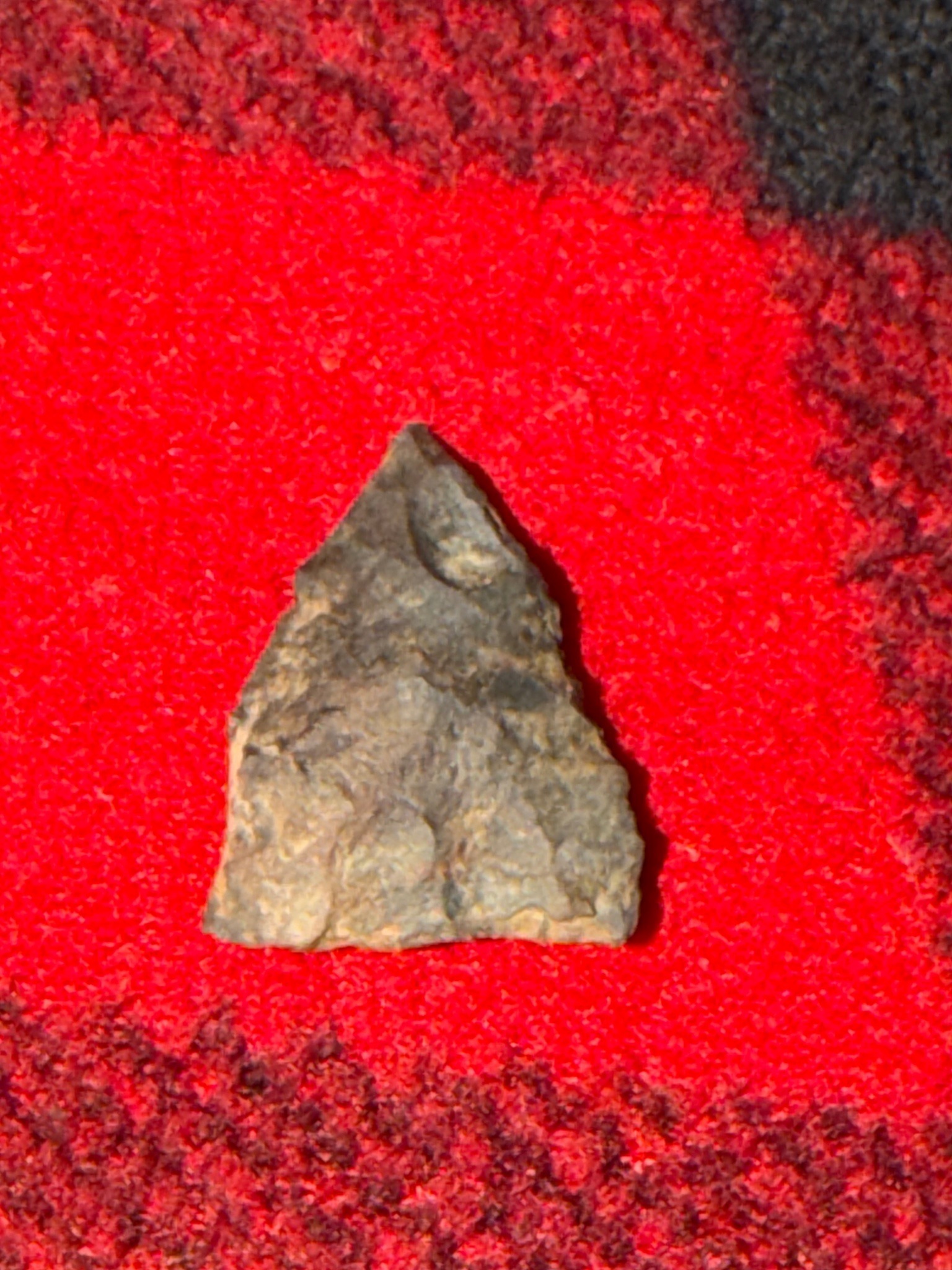
Levanna Triangular Projectile Point
Archaeological Artifacts / Native American Prehistoric Tools

Levanna Triangular Projectile Point

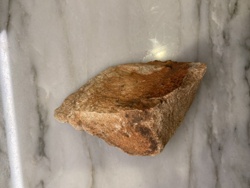
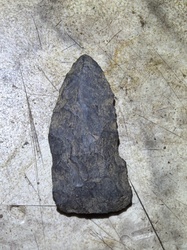
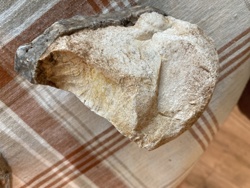
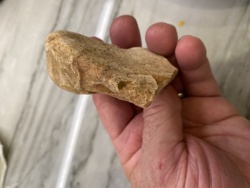
This is a prehistoric triangular projectile point, identified as a Levanna type, commonly found in the Middle to Late Woodland periods (approximately 700 AD to 1350 AD). The artifact is crafted from a dark, cryptocrystalline lithic material, likely a local Pennsylvania chert or weathered jasper, exhibiting a matte grey-to-brownish patina consistent with long-term exposure in fluvial environments like the Susquehanna River basin. The specimen is roughly equilateral to isosceles in shape with a slightly concave base, a diagnostic feature of the Levanna style. It measures approximately 1 to 1.5 inches in length. The manufacturing technique displays bifacial pressure flaking, though the edges show significant wear and river-rolled smoothing, which has softened the original sharpness of the percussion scars. There is evidence of a large flake scar near the tip, possibly from an impact fracture or use-wear. The overall condition is fair to good for a field-find; the tip is somewhat blunted, and the lateral margins show minor nicks and edge-loss consistent with its discovery near a canal and river system. Such artifacts are significant indicators of indigenous hunting and defensive technologies in the Northeastern United States.
Estimated Value

$40 - $65

Basic Information

Category

Archaeological Artifacts / Native American Prehistoric Tools

Appraised On

May 4, 2026

Estimated Value

$40 - $65

Additional Details Provided By Owner

User Provided Information

Found in Beach Haven, Pennsylvania near the canal/susquehanna River

Item Description

This is a prehistoric triangular projectile point, identified as a Levanna type, commonly found in the Middle to Late Woodland periods (approximately 700 AD to 1350 AD). The artifact is crafted from a dark, cryptocrystalline lithic material, likely a local Pennsylvania chert or weathered jasper, exhibiting a matte grey-to-brownish patina consistent with long-term exposure in fluvial environments like the Susquehanna River basin. The specimen is roughly equilateral to isosceles in shape with a slightly concave base, a diagnostic feature of the Levanna style. It measures approximately 1 to 1.5 inches in length. The manufacturing technique displays bifacial pressure flaking, though the edges show significant wear and river-rolled smoothing, which has softened the original sharpness of the percussion scars. There is evidence of a large flake scar near the tip, possibly from an impact fracture or use-wear. The overall condition is fair to good for a field-find; the tip is somewhat blunted, and the lateral margins show minor nicks and edge-loss consistent with its discovery near a canal and river system. Such artifacts are significant indicators of indigenous hunting and defensive technologies in the Northeastern United States.
Get Your Items Appraised

Instant estimates of your treasures with AI-powered instant appraisals

Browse More Appraisals